

Why babies smell nicer than teenagers: a study has won the Ig Nobel Prize


A study on how parents perceive the smell of children of different ages has won the Ig Nobel Prize for Olfaction. Scientists link the pleasant smell of babies to mechanisms of attachment and care.
An international team of scientists has been awarded the 2026 Ig Nobel Prize in the field of smell for their research into how parents perceive the smell of their children. The study showed that the smell of babies and young children is generally rated as particularly pleasant, but this rating decreases as the child grows older.
The award was presented to Ilona Croy, Tomasz Frackowiak, Thomas Hummel and Agnieszka Sorokowska. The ceremony took place on 3 September in Zurich and was held in Europe for the first time.
Details
A questionnaire survey published in 2017 involved 235 parents who assessed the smell of their 367 children. The average age of the parents was 36.9 years, and that of the children was 9.3 years. The older the child, the less pleasant the parents found their smell. The gender of the parent and child did not make a statistically significant contribution to this result.
The authors emphasised that this was a study of perception, rather than a direct chemical comparison of odours. Participants recalled and rated the smell of their children via a questionnaire; therefore, whilst the result shows a consistent age-related correlation, it does not in itself reveal the biological mechanism behind it.
The team later continued their work with odour samples from more than 300 children, involving both parents and people without children. Some of the experiments were accompanied by functional magnetic resonance imaging. According to the researchers, the scent of infants activates areas of the brain’s reward system and may underpin nurturing behaviour.
Around the time of puberty, parents found it more difficult to recognise their own child by smell. Once puberty was over, familiarity with and preference for the smell, as described by the team, appeared to return.
Why this is important
The study adds to our understanding of the so-called ‘infant schema’: adult care may be sustained not only by a young child’s visual features, but also by their scent. The authors suggest that olfactory cues play a role in the formation of attachment between parents and children.
However, the results should not be interpreted as a universal odour profile for all children. The initial study was conducted on a Polish sample and was based on parents’ self-reports. To explain the specific chemical changes that occur with age, separate studies are needed into the composition of odours and their perception across different cultures.
Source
The award was announced by the University of Jena News Service. The official list of laureates and the ‘smell’ category were published by the Ig Nobel Prize Committee.
Original scientific paper: Ilona Kroj, Tomasz Frackowiak, Thomas Hummel and Agnieszka Sorokowska, ‘Babies Smell Wonderful to Their Parents, Teenagers Do Not’, *Chemosensory Perception*, vol. 10, no. 3, pp. 81–87, 2017. DOI: 10.1007/s12078-017-9230-x. The article is available as open access.
Maria Grynevych, project manager, journalist, co-author of Guidebook Sacred Mountains of the Dnieper Region, Lecture Course: Cult Topography of the Middle Dnieper Region.
Related news

Why ‘zombie cells’ accumulate as we age: 5 findings from a new study


Counting to five revealed how children’s inner speech develops: 5 conclusions

Are you thinking quickly right now – or will fatigue get in the way more later on? 5 findings from the study

Same calories – different reactions: 5 insights into ultra-processed food

Popular news

Scientists have identified which childhood experiences are linked to happiness in adulthood

Russian forces struck a public bus in Kramatorsk: 30 dead and 18 injured


Marfan syndrome has been confirmed at the molecular level in domestic cats for the first time

A Russian drone struck the South Bridge in Kyiv: metro services have been suspended

News about war

Russia is plotting to assassinate the heads of European defence firms in order to undermine support for Ukraine — FT
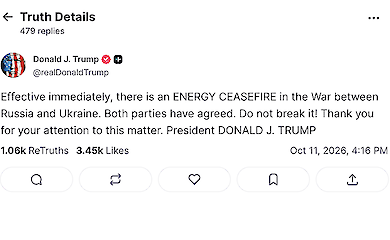
Trump announced an energy truce between Ukraine and Russia. A similar statement was made a month ago
Russian forces struck a public bus in Kramatorsk: 30 dead and 18 injured

The death toll in Pryluky following the Russian missile strike has now risen to 22, including five children