
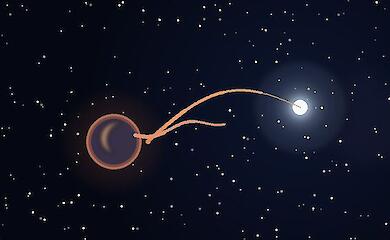
Towards the end of its life, the Sun may eject the giant planets from the system


Astrophysicists have modelled 672 scenarios for the ageing Sun’s loss of mass. If matter is ejected in separate, asymmetrical portions, the orbits of the giant planets could become unstable even before a white dwarf forms. The result depends on the model’s assumptions.
Jupiter, Saturn, Uranus and Neptune may lose their stable orbits as the Sun ages, and some planets may leave the system. This scenario was arrived at by astrophysicists who took into account the loss of stellar mass through individual asymmetric outbursts. We are talking about the distant future, billions of years from now, and the results of a computer model.
The study, published in *The Astrophysical Journal Letters*, was carried out by Konstantin Batygin and Jim Fuller of the California Institute of Technology, and Fred Adams of the University of Michigan. The full text is available on arXiv.
Details
Gradual mass loss preserves the order of orbits
Towards the end of its evolution, the Sun will shed its outer layers and become a white dwarf — a compact stellar remnant. In the model used by the authors, its final mass is around 54 per cent of the Sun’s current mass: the star loses almost half its mass.
With a gradual loss of mass, gravitational attraction gradually weakens and the planets’ orbits become more elongated. In more than 60 control calculations, the distances increased by approximately 1.85 times, but the relative positions of the orbits remained unchanged. Such systems remained stable in long-term calculations.
Asymmetric ejections give the star a recoil
The authors tested another scenario: matter leaves the star in separate portions in different directions. Each asymmetric ejection slightly alters the star’s own velocity, like recoil from the ejection of mass. Thousands of such small jolts gradually alter the motion of the planets relative to the star.
This hypothesis is based on observations of the motions of white dwarfs: these indicate that stellar remnants may undergo a slight change in velocity during formation. However, the exact nature of the Sun’s future ejections remains unknown.
What exactly was modelled
The researchers combined calculations of the star’s evolution using the MESA programme with simulations of the motion of the Sun and the four giant planets using the REBOUND package. The initial positions and velocities of the planets were taken from the JPL Horizons system.
The main simulation run comprised 672 scenarios: seven values for the mass of a single outburst, 48 variants of a random sequence for each, and two modes of mass loss. In one scenario, ejections occurred throughout the giant-star stages; in the other, only during the late stage. After mass loss had ceased, the systems were tracked for a further three billion years.
The scientists measured changes in orbits and orbital period ratios. They considered orbit intersections, the ejection of a planet, or a change in the semi-major axis of an orbit of more than 20 per cent to be signs of instability.
Where did the 96 per cent come from?
In the case of large ejections — approximately one ten-thousandth of the Sun’s mass — 46 out of 48 systems, or about 96 per cent, became unstable when ejections occurred at all stages of the giant phase. With the same mass portions, but with ejections occurring only in the late stage, the result was 40 out of 48, or about 83 per cent.
In the first of these scenarios, 19 out of 48, or about 40 per cent, reached a state of severe disruption in the planets’ orbits even before the formation of a white dwarf. In some calculations, the planets left the system, whilst Uranus and Neptune swapped the order of their orbits.
These percentages relate to specific model settings. Across the entire series of 672 scenarios, including those involving much smaller ejections, 224 were deemed unstable, whilst 448 remained stable. It is not possible to regard 96 per cent as the established probability of our system’s future demise.
Why this is important
A billion years is not a countdown from today
The authors refer to a characteristic timescale of around a billion years following the formation of a white dwarf, although some of the model’s discrepancies begin earlier – during the mass-loss phase itself. This does not mean that the Solar System will disintegrate a billion years from now.
According to NASA, the Sun will remain in its current stage for approximately another five billion years before becoming a red giant. The new study focuses primarily on the fate of the outer planets during the subsequent phases of the star’s evolution.
Previously, the internal dynamic stability of the outer system was estimated to be on the order of 10 to the power of 18 years. Taking into account mass loss and passing stars, other calculations yielded figures of around 30–100 billion years. These estimates were based on different mechanisms; the new model shows that the ejection of material itself could disrupt the order of the orbits much earlier.
What remains unknown
The main assumption is that individual outbursts are asymmetrical and occur independently of one another. Their mass, geometry and timing determine the strength of the perturbations. The authors also regard the extension of this mechanism to an earlier stage of the red giant phase as an assumption, and have therefore tested two scenarios.
In control calculations, separate but spherically symmetric outbursts did not disrupt stability. In other words, it is not only mass loss that is important, but also the star’s recoil.
This study focuses on four giant planets: Earth and the other terrestrial planets are not included in the calculations. Passages near other stars were not modelled either. The study does not determine the exact fate of Earth, but it does propose a mechanism that can be tested by examining the structure of planetary systems around white dwarfs.
Source
Batygin K., Fuller J., Adams F. C. Terminal Instability of the Solar System Triggered by Stochastic Solar Mass Loss. The Astrophysical Journal Letters, 1009(2), L22, 2026. DOI: 10.3847/2041-8213/aea290. Full text by the authors, including methods and limitations.
NASA: stages of stellar evolution. The authors acknowledge funding from the David and Lucille Packard Foundation, the Caltech Centre for Comparative Planetary Evolution, the US National Science Foundation and NASA, including the Emerging Worlds programme.
Mykola Potyka has a wide range of knowledge and skills in several fields. Mykola writes interestingly about things that interest him.
Related news
A rock from the Sahara has been found to be a fragment of Mars dating back at least 4.1 billion years

Mylar has been transformed into durable thermal insulation for lunar bases
Japan is preparing a mission to collect soil samples from a moon of Mars
‘Planet Phoenix’: 5 facts about a world that may have been born from the ashes of its star
Popular news

Genetic evidence of natural selection has been found in dogs near the Chernobyl Nuclear Power Station


A fish with a transparent head was filmed in 4K at a depth of 600 metres


News about war

Russia is threatening to destroy bridges, ports and power stations in Ukraine in order to secure territorial concessions from Kyiv – FT


Emergency power cuts have been introduced in Kyiv and warming centres are being set up — Klitschko


Zelenskyy confirmed that the Russian warning system had been hacked: Ukraine has responded to the Russian Federation’s cyberattack

Stephen Hubbard has returned to the US after four years in prison in Russia: what is known about his case
