

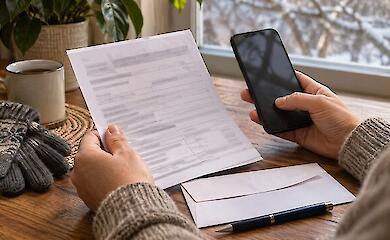
There was no heating, but the full bill arrived: who is responsible for adjusting the bill and what needs to be checked?


In the event of an external fault or a heating fault inside the property, the procedure for correcting the bill in Kyiv varies. We’ll explain what the supplier already records, how to obtain a report and how to check your bill.
If there was no heating but the usual amount has been charged on your bill, first find out the reason for the interruption. In Kyiv, ‘Kyivteploenergo’ explains that the company takes external heating network faults into account itself, but if there is a problem with the internal building system, a report from the property manager and a separate complaint may be required.
These instructions are primarily intended for residents of buildings served by ‘Kyivteploenergo’. The general rules for the recalculation of utility charges are set out in Cabinet of Ministers Resolution No. 127; during emergencies under martial law, the special provisions of Resolution No. 118 also apply. The calculation procedure depends on the cause, the quality of the service, the type of metering and the terms of the contract.
Details
Check the following six points in order: the reason for the lack of heating, the recording of any external faults, documentation of the problem inside the building, a complaint form in the event of substandard quality, the next bill, and the response to your written enquiry. Do not automatically assume that any non-zero amount constitutes a breach: check exactly what is stated on the bill.
1. Clarify where the problem arose
Start with specific dates and the address: when the radiators stopped heating up, how long the outage lasted, and whether it affected the whole building or individual flats. Ask the property manager, the owners’ association or the supplier whether there was an emergency cut to the external network or a fault with the building’s internal equipment. It is best to obtain the reason in writing, rather than relying solely on the temperature in your flat.
If the building is receiving heat but it is cold in just one riser, the likely cause differs from a cut-off in the mains heating supply. This will determine what documentation is required for a further review of your charges.
2. In the event of an external fault, check the automatic interruption log
‘Kyivteploenergo’ states that it independently records periods without heating due to faults on external heating networks and does not charge for the corresponding time. Therefore, first request details of the recorded dates of outages affecting your block and check whether this is reflected in the bills. The supplier’s official procedure does not require each resident to provide a separate report specifically for an external fault they have recorded.
However, Order No. 127 contains exceptions for a number of cases where calculations are based on meter readings. It is not possible to promise the same refund amount to all flats without first checking the billing model.
3. If the fault is inside the building, obtain a report from the property manager
When heating was not supplied due to a fault in the in-building system, the management company, the Owners’ Association (OSMD) or the Housing Co-operative (ZhSK) must report this to the supplier. If this information has not been passed on, the consumer may contact the supplier directly. Ask the property manager to issue a report stating the building’s address, the reason for the disruption and the period during which the service was unavailable. ‘Kyivteploenergo’ explicitly states that such a document serves as the basis for considering a recalculation.
Send a copy of the report to the Utility Services Centre (USC) via the official communication channel or to the supplier’s email address energozbut@kte.kmda.gov.ua. Keep a record of the date of dispatch and the confirmation of receipt. Simply submitting the report does not guarantee a favourable decision: it is considered in light of the circumstances and the billing rules.
4. If heating was provided but the quality was poor, submit a complaint report
Insufficient heating, non-compliance with heating parameters and a complete lack of service are not the same thing. To document substandard quality, the consumer is entitled to call in a representative of the service provider or the property manager to carry out an inspection. Under Order No. 1145, they must arrive within the timeframe stipulated in the contract, but no later than one day after the request is made.
The complaint form must record the date and time of the inspection, the identified breaches and, if established, the date on which the decline in quality began. The document is usually drawn up in duplicate. If the representative fails to arrive within the stipulated time or unreasonably refuses to sign the report, it may be signed by the claimant together with at least two other consumers of the same service from neighbouring premises; the report is then sent to the service provider by registered post. The procedure is explained by the State Energy Supervisory Authority.
5. Check your next bill for the specific period
Compare the bills from before and after the interruption: the address, the billing month, the number of days without heating, the meter readings and the separately stated adjustment. In the event of an emergency, Decree No. 118 stipulates that any recalculations must be reflected in the bills for the month following the recalculation, and information regarding the interruption of service must be taken into account for each block of flats.
A hypothetical example of a check: heating was unavailable from the 12th to the 14th, yet you do not see a separate adjustment on the next bill. This does not necessarily prove an error: check with the supplier to find out in which billing period they recorded the outage, which meter readings were used to calculate your building’s consumption, and which line item reflects the adjustment. Do not deduct three-thirtieths of the total amount yourself: the payment may be calculated based on data from the building or flat meter and may include other components.
6. If the calculation has not been explained, submit a written complaint
In your letter, state your address, account number, the period during which the service was unavailable, the reason for your enquiry, and a request for a breakdown of the charges. Enclose a copy of the payment notice, the property manager’s report or the claim form (if available), and details of any previous correspondence. According to the Central Customer Service Centre’s guidance, for certain recalculations, documents relating to the premises and proof of meter readings may be required; the list is determined on a case-by-case basis.
In the case of a claim form, the service provider must, within five working days of registration, either meet the requirements or provide a reasoned written refusal. In the absence of a substantive response, you may contact the regional office of the State Service for Food Safety and Consumer Protection, and any dispute arising from the results of the inspection shall be resolved in accordance with the procedure established by law, including through the courts. The basis for this is the official procedure for considering claims.
Why this is important
Choosing the wrong course of action delays the correction of the bill. The supplier may already be aware of a fault in the external heating network, in which case it is more useful to request a calculation and check the meter readings. However, a fault inside the property is sometimes not recorded in their records without notification from the property manager: in such cases, you will need a document stating the reason and the exact period during which heating was unavailable.
This guide does not guarantee that all charges will be waived. Special regulations for emergencies during martial law, the use of metering devices and the contractual model may all affect the final calculation. The key is to establish the facts, keep a written record of your correspondence and request a line-by-line explanation of the disputed amount.
Source
‘Kyivteploenergo’: algorithm for recalculating heating charges; CKS: charges and documents; CMU Resolution No. 127 of 6 February 2024 (as amended on 30 May 2026); CMU Resolution No. 118 of 30 January 2026 (as amended on 30 May 2026); Resolution No. 1145 of 27 December 2018; State Energy Regulatory Authority: procedure for drawing up a claim report. The rules and available official clarifications were verified on 2 November 2026.
Maria Grynevych, project manager, journalist, co-author of Guidebook Sacred Mountains of the Dnieper Region, Lecture Course: Cult Topography of the Middle Dnieper Region.
Related news
A subsidy may be withdrawn: why this happens and how to have payments reinstated

How to dispute your utility bill: 7 steps towards a recalculation
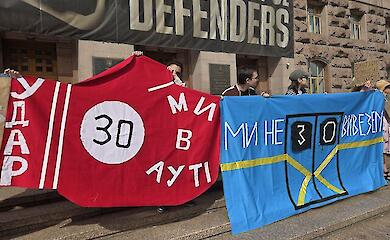
‘We’re out of the loop’: Protests against the 30 UAH fare are taking place again in Kyiv

Popular news

Genetic evidence of natural selection has been found in dogs near the Chernobyl Nuclear Power Station


A fish with a transparent head was filmed in 4K at a depth of 600 metres


News about war

Russia is threatening to destroy bridges, ports and power stations in Ukraine in order to secure territorial concessions from Kyiv – FT


Emergency power cuts have been introduced in Kyiv and warming centres are being set up — Klitschko


Zelenskyy confirmed that the Russian warning system had been hacked: Ukraine has responded to the Russian Federation’s cyberattack

Stephen Hubbard has returned to the US after four years in prison in Russia: what is known about his case