
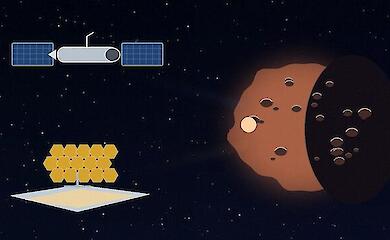
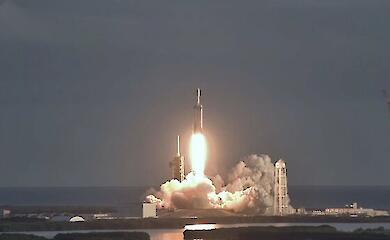
The two BepiColombo spacecraft have begun their final approach to Mercury


The European-Japanese BepiColombo mission has begun the final stage of its journey to Mercury. The transport module has separated, and the two scientific probes are preparing to enter the planet’s orbit.
The two BepiColombo spacecraft have begun their final approach to Mercury
The European-Japanese BepiColombo mission has begun the final stage of its journey to Mercury after eight years in space. On 3 September, the transport module, which had been propelling the spacecraft during their interplanetary journey, successfully separated from the spacecraft pair.
The two scientific orbiters remain docked for the time being. They are scheduled to enter Mercury’s orbit on 21 November 2026, separate in December and begin their scientific operations in April 2027.
Details
BepiColombo is a joint mission between the European Space Agency and the Japan Aerospace Exploration Agency. It comprises the European Mercury Planetary Orbiter and the Japanese Mercury Magnetospheric Orbiter, also known as Mio.
The journey began on 20 October 2018. To slow down and approach the small planet near the Sun, the mission utilised gravitational manoeuvres near Earth, Venus and Mercury.
The transport module separated from the spacecraft more than 200 million kilometres from Earth. The success of the operation was confirmed by radio signals received by deep-space communication stations in Spain and Argentina. According to the ESA, the systems are operating normally, and the solar panels on the European spacecraft are charging its batteries.
After being captured by Mercury’s gravity, the two spacecraft are due to separate on 9–10 December. Mio will study the planet’s magnetic field and its interaction with the solar wind, whilst the European orbiter will investigate Mercury’s surface, composition and internal structure.
Why this is important
BepiColombo will be the first mission in which Mercury is studied simultaneously by two orbiters. This will allow for the comparison of data on the planet’s surface and its magnetic environment, obtained at the same time.
However, the arrival is not yet complete. The successful separation of the carrier module was only the first stage: the spacecraft still have to carry out trajectory corrections, enter orbit and deploy. ESA warns that the exact dates of the next operations may change for technical reasons.
Source
Main source — the European Space Agency’s operational bulletin on BepiColombo’s arrival at Mercury: ESA, Latest updates: BepiColombo’s arrival at Mercury. Further information on the sequence of operations: BepiColombo arrival at Mercury timeline.
Mykola Potyka has a wide range of knowledge and skills in several fields. Mykola writes interestingly about things that interest him.
Related news
‘Planet Phoenix’: 5 facts about a world that may have been born from the ashes of its star



A hidden star cluster that is difficult to classify has been discovered in the Milky Way
Starship entered orbit for the first time, but exploded after landing in the Pacific Ocean
Popular news

Scientists have identified which childhood experiences are linked to happiness in adulthood


Russian forces struck a public bus in Kramatorsk: 30 dead and 18 injured


Marfan syndrome has been confirmed at the molecular level in domestic cats for the first time

A Russian drone struck the South Bridge in Kyiv: metro services have been suspended
News about war

Russia is plotting to assassinate the heads of European defence firms in order to undermine support for Ukraine — FT

Trump announced an energy truce between Ukraine and Russia. A similar statement was made a month ago
Russian forces struck a public bus in Kramatorsk: 30 dead and 18 injured

The death toll in Pryluky following the Russian missile strike has now risen to 22, including five children