
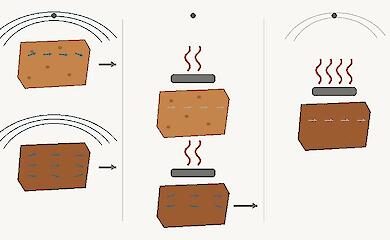

The Hall effect has been made to work ‘sideways’: a single nanodevice has detected a field in two directions


Physicists at Carnegie Mellon have experimentally demonstrated an unusual form of the Hall effect: a signal is generated not only when the magnetic field is perpendicular to a thin film, but also when it is parallel to its surface. This enables a single ultrathin device to distinguish between several directions of the magnetic field.
Physicists at Carnegie Mellon University have, for the first time, experimentally demonstrated an unusual variant of the Hall effect: an electrical signal arises not only when the magnetic field is directed perpendicular to a thin film, but also when the magnetisation lies parallel to its surface.
As a result, a single ultra-thin device was able to respond to a magnetic field in several directions. In the future, this could simplify the design of sensors, which currently often require several sensing elements to measure different components of the field.
Details
The Hall effect has been known since the 19th century. When a current flows through a material and a magnetic field is directed across it, the moving charges are deflected to one side. This causes a voltage to appear across the edges of the sample. Physicists use this to determine which charge carriers are moving within the material, how many there are, and how freely they move.
For a long time, it was thought that the component of magnetisation directed perpendicular to the thin film was the most important factor for this response. Theoretically, the possibility of observing the anomalous Hall effect even with magnetisation along the surface had been discussed, but it had not been possible to demonstrate this experimentally.
The Carnegie Mellon team assembled a device comprising several atomic layers of tantalum iridium telluride (TaIrTe₄) and the magnetic material Cr₂Ge₂Te₆. The layers are arranged so closely together that the magnetic properties of one material influence the neighbouring one, without depriving it of its characteristic electronic properties.
In this device, the researchers detected two signals simultaneously: a conventional signal associated with magnetisation transverse to the film, and an additional signal where the magnetisation is aligned along its surface. In an article in the journal *Nature Materials*, the authors also report that the magnitude of the unusual signal can be controlled by the electrical voltage applied to the gate.
Calculations show that the unusual symmetry of the system and the interaction between the motion of electrons and their magnetic properties at the interface between the two layers play a key role. However, the exact mechanism is still being clarified: the authors themselves note that a more detailed investigation of thin TaIrTe₄ layers is needed to provide a definitive answer.
There is also a practical limitation. The effect was observed in a specially designed structure, where the magnetic layer became ferromagnetic at low temperature. The team is now testing other combinations of materials and trying to understand whether the same response can be achieved at room temperature.
Why this is important
The main value of this work lies in the fact that a single miniature device can distinguish between several directions of a magnetic field. Among the possible applications, the authors cite vector magnetometry — the measurement not only of the field’s strength but also of its direction.
Such sensors have potential applications in electronics, transport, navigation and medical equipment. If the desired effect can be consistently achieved at normal temperatures, complex multi-coordinate measurements could be carried out using a simpler system.
However, a finished sensor is still a long way off. The work primarily demonstrates a new physical principle within a specially designed atom-thin structure. It still needs to be made stable, reproducible and suitable for use outside the laboratory.
Source
Original article: Phys.org — ‘Physicists take Hall effect in a new direction’, 31 August 2026. The article is based on a press release from Carnegie Mellon University.
Press release: Carnegie Mellon University — ‘CMU Physicists Take Hall Effect in a New Direction’, by Amy Pavlak Laird.
Scientific publication: I-Hsuan Kao, Ravi Kumar Bandapelli, Zhenhong Cui et al., ‘In-plane anomalous Hall effect in a low-dimensional system’, *Nature Materials*, published 28 May 2026. DOI: 10.1038/s41563-026-02611-9.
Mykola Potyka has a wide range of knowledge and skills in several fields. Mykola writes interestingly about things that interest him.
Related news


Physicists have observed a quantum leap in sound in real time for the first time


Heat has a ‘memory’: physicists have developed a new theory of heat transfer
Popular news

Scientists have identified which childhood experiences are linked to happiness in adulthood


Russian forces struck a public bus in Kramatorsk: 30 dead and 18 injured


A Russian drone struck the South Bridge in Kyiv: metro services have been suspended

New Zealand has successfully restored populations of the country’s heaviest insect
News about war

‘There has been significant damage to energy infrastructure following attacks by the Russian Federation’ – Zelenskyy

Russia has launched a ballistic missile strike on Kyiv: a residential building has been hit, and there are casualties and injured people

Russian ballistic missile strike on a thermal power station in Kyiv: what is known

Russia is plotting to assassinate the heads of European defence firms in order to undermine support for Ukraine — FT