

Stephen Hubbard has returned to the US after four years in prison in Russia: what is known about his case


Stephen Hubbard, an American, spent more than four years in Russian custody after being captured in occupied Izium. We have compiled a verified biography, the circumstances of his case, evidence of ill-treatment and details of his release, without referring to Russian sources.
On 21 October 2026, Russia released 74-year-old US citizen Stephen Hubbard, who had been captured by Russian forces in Ukraine in the spring of 2022. More than four years later, he flew to the United States and was taken to San Antonio for a medical examination. His release was confirmed by the Associated Press, CBS News and Hubbard’s lawyer in comments to AFP.
The Russian side described Hubbard as a mercenary and claimed that he had been fighting on the side of Ukraine. His family, US lawyers and the Ukrainian authorities disputed these allegations. In January 2025, the US officially recognised him as ‘wrongfully detained’, which enabled the US government to carry out separate inter-agency efforts to secure his release. Reuters reported on this status, citing sources in Washington; the US State Department explains the mechanism behind such a recognition.
Details
Who is Stephen Hubbard
Hubbard grew up in Big Rapids, Michigan. He served in the US Air Force and subsequently in the National Guard. According to US military data cited by Defence News, he served on active duty in the Air Force from March 1974 to March 1978 and was an administrative specialist.
Hubbard later obtained a master’s degree in English and taught the language in Japan for around 25 years. He then lived in Cyprus, before moving to Izium in the Kharkiv region in 2014 with his Ukrainian partner. After they split up, he remained in Ukraine. His sister, Patricia Hubbard Fox, told Reuters that her brother lived on a small pension and had little contact with local residents. ABC News reported that in Izium he continued to teach English online and spoke almost no Russian or Ukrainian.
His sister last spoke to him in September 2021. By the time the full-scale Russian invasion began, Hubbard was around 70 years old.
How he came to be with the Russian military
Hubbard was in Izium during the Russian offensive in the spring of 2022. Russian reports later claimed that he had been detained in April 2022 near a Ukrainian military checkpoint. Reuters emphasised that it had been unable to independently verify the circumstances of his capture.
There is another, more specific account. Ukrainian police investigating war crimes in Izium established that a group of Russian soldiers took Hubbard from his home in April 2022, ABC News reported. His American lawyer, Martin De Luca, later told Reuters that Hubbard himself had described the incident in exactly this way: Russian soldiers came to his home and took him away.
In May 2022, videos appeared online showing a man whom relatives identified as Hubbard. In one, he is answering questions about the war; in another, he is shown with his hands tied and being subjected to physical abuse. Reuters noted that it had been unable to independently verify where and under what circumstances these recordings were made. Therefore, they cannot be regarded as reliable evidence of Hubbard’s voluntary statements.
What Russia accused him of
The Russian prosecution alleged that in February 2022, Hubbard joined a unit of the Ukrainian territorial defence forces, underwent training, received weapons and ammunition, and was due to receive around $1,000 a month. He was also alleged to have been on duty at a checkpoint. These claims are cited by Reuters, the Associated Press and other international media outlets as the position of the Russian prosecution.
Russian state media reported that Hubbard had pleaded guilty. We do not provide direct links to these Russian publications. Independent sources merely note the fact of such a report. Hubbard’s family doubted that the confession could have been voluntary. His sister described her brother as a pacifist, whilst his lawyer, De Luca, stated that Hubbard later explicitly denied any involvement in a military or combat unit. In 2026, the lawyer told CBS News that his team had found no evidence of Hubbard’s military service and had repeatedly requested documents to substantiate the Russian charges.
The Ukrainian authorities also found no evidence of his service in a Ukrainian military unit, according to AFP; this conclusion was reported by Deutsche Welle.
A closed-door trial and nearly seven years in prison
In September 2024, Hubbard’s case came to trial in Moscow. The trial was held behind closed doors. On 7 October 2024, he was sentenced to six years and ten months in prison on charges of mercenary activity. This was reported by The Washington Post, RFE/RL and Reuters.
American diplomats at that time did not have proper consular access to Hubbard. The State Department stated that Russia had not granted the US access to him and had provided extremely limited information about his condition and whereabouts. This fact was confirmed by Reuters.
His family and the embassy were left in the dark for a long time as to where he was being held
Following his sentencing, Hubbard effectively disappeared within the Russian prison system. His American lawyers became involved in the case in February 2025. According to De Luca, at that point neither the family nor the US embassy knew exactly which facility he was being held in. It was not until April 2025 that the lawyers established that Hubbard was being held in Mordovia. The lawyer told CBS News and Reuters about this.
Reuters also reported that, prior to his trial, Hubbard had been moved between several Russian detention centres. According to a former Ukrainian prisoner of war, he spent some time in Pre-trial Detention Centre No. 2 in Novozybkov, Bryansk Oblast, and then in Penal Colony No. 7 in the village of Pakino, Vladimir Oblast. Subsequently, his lawyers located him in Mordovia.
Once his whereabouts had been established, his lawyers managed to arrange legal visits, send him money for food and essential items, and secure a brief telephone call with his son. Prior to this, the family had had almost no proper contact with Hubbard for nearly three years.
What is known about ill-treatment and torture
Reports of Habbard’s ill-treatment emerged even before his release and did not come solely from his family. In October 2024, a former Ukrainian prisoner of war, who had been held alongside the American, told AFP of regular beatings, starvation, harassment by dogs, humiliation and the use of electric shocks. A detailed account of the testimony was published by Deutsche Welle, citing AFP.
These statements have not been verified by an independent court; it is therefore correct to refer to them as testimonies and allegations from former prisoners, rather than as facts established in court. However, following his release, Hubbard’s family also reported similar details. His sister told the Associated Press that her brother had endured severe starvation and beatings and had survived partly thanks to the help of Ukrainian prisoners.
In another interview, his sister stated that he had been in good health prior to his capture, but that after four years in captivity he had developed serious health problems. There has not yet been a public, independent medical assessment of these diagnoses. Hubbard’s son, Joseph Coleman, also told CBS News that during a conversation in May 2025, his father sounded extremely psychologically exhausted and had almost lost hope of being released.
Why the US recognised him as wrongfully detained
In January 2025, Washington granted Hubbard the status of ‘wrongfully detained’. This is not merely a political formulation: following such a decision, the State Department and other US agencies develop a specific strategy for the release of the individual citizen in question. The criteria and mechanism are outlined on the US State Department’s official website.
At the time of his release, Hubbard was the last US citizen in Russia whom the State Department formally classified in this category, although other Americans remained in Russian custody whose families also contested the charges. This was reported by CBS News.
How he was released
The release took place on 21 October 2026 during a visit to St Petersburg by US President’s Special Envoy Steve Whitcroft. Donald Trump stated that he had personally asked Vladimir Putin to release Hubbard during a telephone conversation the previous week. There was no formal prisoner exchange: Trump emphasised that a ‘swap’ was not required. This has been confirmed by the Associated Press and CBS News.
However, the claim that ‘the US gave nothing in return’ should be treated with caution. Trump himself publicly linked Hubbard’s release to the decision not to impose new sanctions against Russia at that time. He said that imposing sanctions would have derailed the negotiations over Hubbard. CBS News noted that the decision not to impose new restrictions took place a few days before the release. This does not prove the existence of a formal ‘sanctions in exchange for Hubbard’ deal, but it does show that the release took place within a broader diplomatic context.
Whitcoff personally met the released Hubbard in St Petersburg. According to the Los Angeles Times, the special envoy also introduced him to the Russian negotiator Kirill Dmitriev and stated that the latter had played a significant role in achieving the outcome. We do not provide a direct link to the Russian statements regarding the pardon procedure.
Hubbard did not immediately realise that he was actually being released
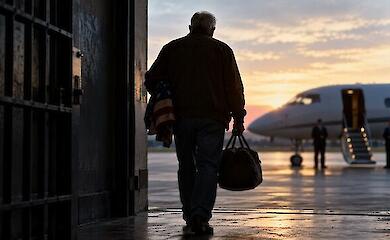
After his return, the family revealed a new detail. According to his sister, Hubbard was unsure until the very last moment where he was being taken, and feared he might be killed. He only realised he was being released when he reached the aeroplane and saw the American flag. Patricia Hubbard Fox recounted this story to the Associated Press.
Late in the evening on 21 October, Hubbard arrived in the US. He landed in San Antonio, where he underwent a medical examination — a standard procedure for Americans returning after a long period of imprisonment abroad. This was reported by CBS News. His family expect that, once he has received treatment, he will be able to spend time with his relatives; his sister had previously said she was ready to take him in at her home in Colorado.
Why this matters
Stephen Hubbard’s story differs from most cases involving Americans detained whilst already on Russian territory. He was captured by the Russian military in an occupied Ukrainian city, after which he was transferred to the Russian detention system and only, two and a half years later, publicly tried in Moscow. This makes the case part not only of Russian-American ‘hostage diplomacy’, but also of the broader issue of the detention of civilians during the Russian occupation of Ukrainian territories.
There remains a fundamental discrepancy in the accounts of the case. Russia claimed that Hubbard was an armed mercenary. His family, lawyers and the Ukrainian side say that no evidence of his involvement with Ukrainian forces has been found. Reuters separately noted that it was unable to independently establish the circumstances of his capture or verify the Russian version of events. Therefore, Hubbard cannot be described as a proven participant in hostilities.
Equally significant is the question of the conditions of his release. There was no formal prisoner exchange, but the US President himself linked the outcome to the decision not to impose new sanctions during the negotiations. As yet, there are no public documents that would make it possible to establish whether any additional agreements existed between Washington and Moscow.
Following Hubbard’s release, questions remain regarding his health, a possible investigation into reports of torture, and the fate of other Americans held in Russian custody. New information on this matter may emerge once Hubbard himself has undergone medical and psychological rehabilitation and, if he so wishes, speaks publicly about his four years in prison.
Source
- Reuters: biography, circumstances of his abduction, charges, status as ‘wrongfully detained’
- Reuters: Hubbard’s account of his abduction from his home, the search for his place of detention, and the lack of consular access
- Associated Press: release on 21 October 2026 and the political context
- Associated Press: his sister’s account following his release, starvation, beatings and the moment Hubbard realised he was free
- CBS News: the role of Trump and Whitcoff, the absence of a formal exchange and the link to sanctions negotiations
- CBS News: interviews with his son and lawyer, the search for Hubbard, his condition in detention and the defence’s position
- ABC News: life in Izium and Ukrainian police details of Hubbard’s capture from his home
- Deutsche Welle / AFP: testimony from a former Ukrainian prisoner of war regarding ill-treatment
- Defence News: details of Hubbard’s service in the US Air Force
- US State Department: what the ‘wrongfully detained’ status means
Maria Grynevych, project manager, journalist, co-author of Guidebook Sacred Mountains of the Dnieper Region, Lecture Course: Cult Topography of the Middle Dnieper Region.
Related news
Callas commented on Putin’s invitation to the G20 summit in the US


The US may scale back intelligence-sharing with Germany: what has caused the tension
Trump called those who urged him to impose sanctions on Russia "foolish"
Popular news

Genetic evidence of natural selection has been found in dogs near the Chernobyl Nuclear Power Station

A fish with a transparent head was filmed in 4K at a depth of 600 metres

News about war
Russia is threatening to destroy bridges, ports and power stations in Ukraine in order to secure territorial concessions from Kyiv – FT
Emergency power cuts have been introduced in Kyiv and warming centres are being set up — Klitschko

Zelenskyy confirmed that the Russian warning system had been hacked: Ukraine has responded to the Russian Federation’s cyberattack
Stephen Hubbard has returned to the US after four years in prison in Russia: what is known about his case
