

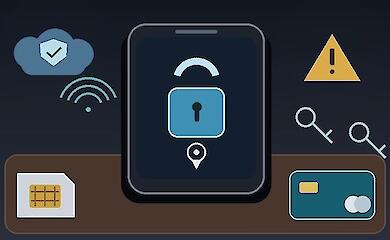
Should you restart your smartphone once a week? What the experts say


Should we make it a security rule to reset our smartphones every week? We’ve compared the NSA’s recommendations, an ESET expert’s view, the latest findings from the Amnesty Security Lab, and Apple’s advice for people at increased risk of targeted attacks.
Restarting your smartphone once a week can be a useful extra layer of protection, but it is no substitute for system updates and does not guarantee that the device is free from spyware. The NSA recommends switching your phone off and on once a week, whilst experts at ESET, Amnesty Security Lab and Apple place this advice in a more limited context.
SocPortal has compared four expert positions. This is neither a poll nor a ranking: the sources address different scenarios — ranging from everyday digital hygiene to attacks by commercial spyware on journalists and activists.
Details
The short answer: a weekly restart can be added to basic digital hygiene: some intermittent malicious processes do indeed stop running after a restart. However, you shouldn’t treat restarting as your primary line of defence. For most people, it is more important to install updates promptly, use a strong passcode and two-factor authentication, avoid clicking on unexpected links, and install apps from official app stores. If there is a risk of a targeted spyware attack, additional measures and expert assistance are required.
How we compared the answers. We separated two questions that are often confused: does a restart reduce the risk in general, and can it stop a malicious process that is already running? Sources and their validity were verified on 13 September 2026. It is precisely because of the difference in scenarios that the recommendations appear contradictory.
NSA: restarting once a week is a sensible basic measure
In its ‘Mobile Device Best Practices’ guide, the US National Security Agency explicitly recommends switching a mobile device off and on completely once a week. In the threat matrix, this measure is listed for spear-phishing attacks involving malware installation and for zero-click exploits.
However, an important detail is often lost in the retelling: the NSA does not promise guaranteed protection. In the guidance itself, weekly rebooting is listed amongst measures that may sometimes help prevent or mitigate specific attacks. Alongside these are far more general recommendations — to update the system and applications as soon as possible, not to open unknown links or attachments, and not to install programmes from unverified sources.
What this means for the reader: the NSA suggests restarting as one layer of protection, not as a substitute for updates or caution.
Jake Moore from ESET: updates are more important than the ritual of rebooting
Jake Moore, Global Security Advisor at ESET, emphasises a different point. In ESET’s latest recommendations for iPhone owners, he identifies keeping the device up to date as the key practical step, and also advises checking devices linked to an Apple ID, deleting unknown apps, using a strong password and two-factor authentication.
Commenting specifically on the NSA’s recommendation for a weekly restart, Moore said that regular restarts can be useful, but the main security benefit comes from keeping the device up to date. In an interview with Forbes, he put it even more bluntly: in his view, regular restarts are more beneficial for the device’s performance and battery life than as a standalone cyber-security measure.
Why the view differs: Moore is referring to the typical user and the most common scenarios — phishing, account theft and outdated software. For these, a timely patch is indeed more important than a scheduled restart.
Amnesty Security Lab: a recent example where a restart actually removed spyware
A study by the Amnesty International Security Lab, published in February 2026, provides a rare forensic example. On the iPhone of Angolan journalist Teixeira Cândido, researchers discovered an active infection with Predator — commercial spyware from Intellexa. According to the analysis, the malicious process was running on the device on 4 May 2024, and by the evening of the same day, the infection had disappeared after the phone was restarted.
Afterwards, the attackers attempted to re-infect the device via links on 11 further occasions. The researchers believe these attempts failed, likely because the links no longer opened.
However, one cannot conclude from this incident that a restart ‘cures’ any infection. In the same report, Amnesty notes that the phone was running an outdated version of iOS with known security vulnerabilities. Furthermore, there are pieces of malware capable of persisting on a device, and an attacker may attempt to infect it again.
What this example shows is that restarting a device can, in practice – rather than just in theory – disrupt the operation of some non-persistent implants. But this is merely a temporary hindrance to the attacker, not a reliable preventative measure.
Apple: for people under targeted attack, restarting is too weak a strategy
In its recommendations for users whom the company considers potential targets of mercenary spyware, Apple does not emphasise weekly reboots. Recipients of threat notifications are advised to enable Lockdown Mode and seek specialist help, for example from the Digital Security Helpline run by Access Now.
For all other users, Apple lists basic precautions: install the latest version of the operating system, secure the device with a passcode and biometrics, enable two-factor authentication, use strong, unique passwords, and do not open links or attachments from unknown senders.
The reasoning here is different: if the risk is so high that a person is being personally targeted with expensive commercial spyware, simply getting into the habit of restarting your phone is not enough. You need to minimise your attack surface and seek specialist help.
Why this is important
The different answers given by experts do not necessarily contradict one another. The NSA responds to the question ‘what simple additional habit can be adopted’ by asking, ESET asks ‘what will have the greatest effect for the average user’, Amnesty asks ‘can a restart interrupt a complex infection that is already active’, and Apple asks ‘what should a person at high risk of a personalised attack do’.
For the average iPhone or Android owner, the practical priorities are as follows: first, system and app updates; then, ensuring the device is securely locked, using two-factor authentication, and being cautious with messages and links. A weekly reboot can be added as an inexpensive extra layer of protection, but it should not be taken as an indication that the phone is ‘clean’.
For journalists, human rights activists, politicians, diplomats and others who may be targets of commercial spyware, the threshold for caution is higher. If an official notification of a targeted attack has been received, or there are serious grounds for suspecting surveillance, it is best not to limit oneself to simply restarting the device: use enhanced security measures and consult digital security specialists.
Source
- National Security Agency, Mobile Device Best Practices, an NSA guidance note recommending that devices be switched off and on weekly.
- ESET, How to Tell If Your iPhone Has Been Hacked (2026), advice from Global Security Advisor Jake Moore.
- Forbes, Why The NSA Says Reboot Your iPhone Or Android Every Week, a commentary by Jake Moore on the role of reboots and updates.
- Amnesty International Security Lab, Journalism under attack: Predator spyware in Angola, 18 February 2026.
- Apple Support, About Apple threat notifications and protecting against mercenary spyware, updated 13 August 2026.
Mykola Potyka has a wide range of knowledge and skills in several fields. Mykola writes interestingly about things that interest him.
Related news

Scientists have discovered why the electricity grid fluctuates every 60 seconds


A drone gives itself away by leaving an ‘invisible trail’ — they have learnt how to detect it without radar

How to store family photos and videos so you don’t lose your archive
Popular news

Genetic evidence of natural selection has been found in dogs near the Chernobyl Nuclear Power Station


A fish with a transparent head was filmed in 4K at a depth of 600 metres


News about war

Russia is threatening to destroy bridges, ports and power stations in Ukraine in order to secure territorial concessions from Kyiv – FT


Emergency power cuts have been introduced in Kyiv and warming centres are being set up — Klitschko


Zelenskyy confirmed that the Russian warning system had been hacked: Ukraine has responded to the Russian Federation’s cyberattack

Stephen Hubbard has returned to the US after four years in prison in Russia: what is known about his case
