
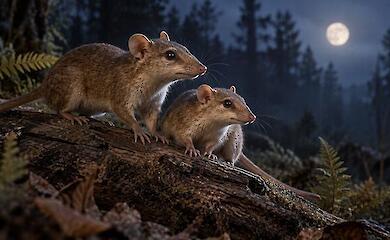
Scientists have discovered a Denisovan forearm bone for the first time: it was revealed by ancient squirrels


In China, five Denisovan remains have been confirmed on the basis of ancient proteins, including the first known fragment of their radius. The discovery suggests that Denisovans lived in south-western China approximately 167,000–134,000 years ago.
In the Bianfu Cave in the Chinese province of Yunnan, scientists have confirmed the discovery of five Denisovan remains at once — three bone fragments and two teeth. Among them was the first known fragment of a Denisovan radius, that is, one of the two bones of the forearm.
The individuals were identified not through DNA, but through preserved ancient proteins. The study has been published in the journal *Nature*.
Details
Bianfu Cave is situated in south-western China. Previously, 1,366 stone tools and more than 64,000 mammalian remains had been found in its cultural layers. Most of the bones are heavily fragmented, making it almost impossible to identify human remains by appearance alone.
The researchers first manually examined over 60,000 bone fragments and selected 22 samples which, based on their size, thickness and structure, could have belonged to humans. They then applied ZooMS — a method for determining the origin of bones based on collagen proteins — and a more detailed proteomic analysis.
As a result, two fragments of the parietal bones of the skull and the proximal part of the radius – that is, the part closer to the elbow – were found to be human. The scientists also analysed two previously discovered teeth. All five samples contained the COL1A2 R996K variant of the collagen protein, which is characteristic of Denisovans. Phylogenetic analysis of the protein sequences also linked each sample to the known Denisovan specimen Denisova 3 with 100 per cent probability in the model used.
The radius comes from a layer dating back approximately 148–134 thousand years. Another skull fragment was found in an older stratum dating back to around 167–150 thousand years ago. Thus, the confirmed presence of Denisovans at Bianfu spans a period of approximately 167–134 thousand years ago.
Based on the proteins in the enamel, the researchers also established that both teeth studied belonged to males. The radius itself proved to be anatomically unusual: some of its features resemble those of Neanderthals, whilst the overall shape and geometry of the neck are closer to those of modern humans.
Why this is important
For a long time, our knowledge of the Denisovans was based mainly on DNA and a very small number of bones and teeth. Particularly few skeletal remains below the head have been found. Therefore, the first confirmed fragment of a long bone provides a rare opportunity to study not only the face and teeth, but also the physique of this group of people.
The discovery also fills a geographical gap. Bianfu lies between the Tibetan Plateau, East, South and South-East Asia. In terms of the number of molecularly confirmed remains, this cave is now second only to Denisova Cave in Siberia amongst Denisovan sites.
There are important limitations. The researchers obtained only a single fragment of a radius bone, so it is not possible to reconstruct the appearance, hand strength or lifestyle of the Denisovans from it. The authors’ conclusion regarding possible specific biomechanical stresses is an interpretation of the morphology, rather than direct evidence of behaviour.
Furthermore, proteins allow the remains to be confidently attributed to the Denisovans, but provide less information about the kinship of individual populations than ancient DNA. The authors explicitly note that there is as yet insufficient data to determine which specific Denisovan lineage the Bianfu inhabitants belonged to, or what contribution they may have made to the genomes of modern humans. The age of the finds is also based primarily on the dating of the cave layers: direct uranium-serium dating of the bones in this case provides only a minimum age.
Source
Huiyun Rao, Song Xing, Qijun Ruan et al. Ancient proteins identify various Denisovan remains from Southwest China. Nature, 2026. DOI: 10.1038/s41586-026-10976-9.
Original publication: Nature.
An independent researcher, interested in archaeology and sacred geography. He researches them and writes about them.
Related news
The letters have shed light on the role of Baghdad’s merchants in the history of ancient Kish

Bones from ancient dwellings have revealed evidence of violence in Scandinavia


Egypt is set to send the Fayum portraits abroad for the first time: 6 facts
Coca leaves have been found in Peru alongside sacrificed llamas
Popular news

Scientists have identified which childhood experiences are linked to happiness in adulthood

Russian forces struck a public bus in Kramatorsk: 30 dead and 18 injured

A Russian drone struck the South Bridge in Kyiv: metro services have been suspended

New Zealand has successfully restored populations of the country’s heaviest insect
News about war

‘There has been significant damage to energy infrastructure following attacks by the Russian Federation’ – Zelenskyy

Russia has launched a ballistic missile strike on Kyiv: a residential building has been hit, and there are casualties and injured people
Russian ballistic missile strike on a thermal power station in Kyiv: what is known

Russia is plotting to assassinate the heads of European defence firms in order to undermine support for Ukraine — FT