

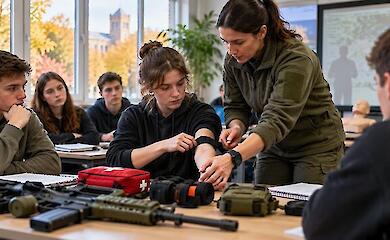
School tablets have revealed how the hundreds of gods were taught in Babylonia


An analysis of school cuneiform tablets from the first millennium BC has shown that trainee scribes and specialists studied the gods, temples and rituals not as a separate subject, but as part of a general curriculum.
In the schools of ancient Babylonia, there was no specific subject that could be described as a ‘religion lesson’. Nevertheless, future scribes, officials and temple specialists systematically studied the names of the gods, their attributes, temples, rituals and the relationships between humans and deities. This is the conclusion reached by Assyriologist Shana Zaya of Vrije Universiteit Amsterdam, following her analysis of cuneiform school texts from the first millennium BC.
The study has been published in the journal *Iraq*. The author examines educational texts from Babylonia as evidence of what religious knowledge was considered essential for future members of the educated elite.
Details
Zaya studied school tablets and educational texts from cities in Babylonia, including Babylon and Nippur, and compared them with what graduates of such schools went on to do in their adult lives. Pupils learnt cuneiform by copying word lists, literary texts, hymns, narratives and lists of divine names.
The research shows that religious knowledge was integrated into the standard curriculum for scribes. Pupils learnt the names and characteristics of the gods, the structure of temple worship, sacred sites and concepts regarding the relationship between gods and humans. At the same time, a significant part of the curriculum was not religious at all: it included texts about kings, language exercises and even humorous works.
The curriculum varied from city to city. In Babylon, the capital and its patron god, Marduk, held a special place. In Nippur, by contrast, the educational tradition reflected the local religious heritage and the cult of Ninurta more strongly. This suggests that the school not only imparted a general body of knowledge but also reinforced local identity.
Some exercises could serve both as schoolwork and as religious acts: tablets bearing educational texts were dedicated to the gods in temples. The knowledge acquired was then applied in professions requiring the performance of rituals, the interpretation of texts, astronomical or medical practices, as well as in public service.
The author emphasises that educated specialists did not merely preserve traditions mechanically. A thorough knowledge of the ancient texts enabled them to adapt religious concepts to political and social changes, including whilst working for the royal authority.
However, the study does not describe a single ‘Babylonian school’ in full detail. The surviving tablets are unevenly distributed, the provenance of some texts is disputed, and the curricula of individual cities are reconstructed from an incomplete corpus. Consequently, the conclusions relate primarily to the known written materials from the first millennium BCE, rather than to all forms of education in Mesopotamia.
Why this is important
This study demonstrates why the modern distinction between ‘secular’ and ‘religious’ education does not apply well to ancient Mesopotamia. For a future scribe, knowledge of the language, royal ideology, the names of the gods and temple practices all formed part of a single professional training programme.
School tablets also offer a rare opportunity to see how cultural tradition was reproduced in practice: not only through official rituals, but also through the everyday copying of texts by pupils. Regional differences between Babylon and Nippur show that education simultaneously preserved a common written culture and local versions of religious memory.
However, such tablets allow us to reconstruct, first and foremost, the education of the educated male elite—future scribes and specialists. They reveal considerably less about how the rest of Babylonia’s inhabitants acquired religious knowledge.
Source
Shana Zaia. “Gods in the Classroom: Religion and Education in 1st Millennium BCE Babylonia”. Iraq, published online on 24 September 2026. DOI: 10.1017/irq.2026.10057. The article is available under a CC BY 4.0 licence.
News source: Phys.org.
An independent researcher, interested in archaeology and sacred geography. He researches them and writes about them.
Related news
Egypt is set to send the Fayum portraits abroad for the first time: 6 facts

Coca leaves have been found in Peru alongside sacrificed llamas
Skulls from Egyptian royal tombs have pointed to human sacrifices

‘Flat head syndrome’ existed almost 3,000 years ago: what scientists have discovered

Popular news

Scientists have identified which childhood experiences are linked to happiness in adulthood

Russian forces struck a public bus in Kramatorsk: 30 dead and 18 injured


Marfan syndrome has been confirmed at the molecular level in domestic cats for the first time
A Russian drone struck the South Bridge in Kyiv: metro services have been suspended
News about war

Russia is plotting to assassinate the heads of European defence firms in order to undermine support for Ukraine — FT

Trump announced an energy truce between Ukraine and Russia. A similar statement was made a month ago
Russian forces struck a public bus in Kramatorsk: 30 dead and 18 injured
The death toll in Pryluky following the Russian missile strike has now risen to 22, including five children