

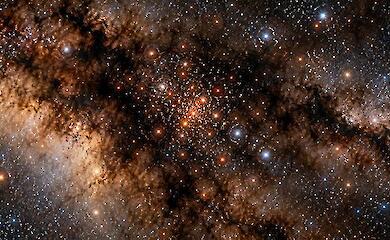
‘Planet Phoenix’: 5 facts about a world that may have been born from the ashes of its star


Astronomers have found evidence of an unusual world orbiting the white dwarf HS 0209+0832. The star’s chemical composition and a 4.4-day signal detected by TESS point to a planetary candidate that may have formed after the star’s death.
Astronomers have found evidence of a second-generation planet candidate orbiting the white dwarf HS 0209+0832. Such a world may not have formed alongside its star, but later — from material ejected by the star as it evolved into a white dwarf.
The study has been published in *Nature Astronomy*. The researchers emphasise that this is still only a candidate: the planetary explanation is consistent with the observations, but requires further confirmation.
Details
1. The white dwarf turned out to be unusually rich in heavy elements
Zinc, copper and, in particular, large amounts of niobium were detected in the atmosphere of HS 0209+0832. According to the researchers, the niobium content was found to be more than a thousand times higher than the solar level. At the same time, elements typical of rocky planetary material – primarily iron and silicon – are present in unusually low quantities.
This chemical composition bears little resemblance to the familiar scenario in which a white dwarf absorbs the remnants of asteroids or shattered rocky planets. It is precisely this chemical anomaly that has become the main argument in favour of a less common scenario.
2. The chemistry points to material produced by a dying star
Niobium and a number of other heavy elements are formed in the so-called s-process — the slow capture of neutrons inside stars during the late stages of their evolution. When such a star becomes a red giant and sheds its outer layers, the material enriched with heavy elements is ejected into the surrounding space.
The authors believe that some of the ejected material may have coalesced into a new disc and subsequently formed a planet. In that case, the object near HS 0209+0832 no longer belongs to the system’s first generation of planets, but to the next — one that formed after the death of the parent star.
3. TESS detected a recurring signal every 4.4 days
Data from NASA’s TESS space telescope provided further evidence. The system’s brightness varies with a period of approximately 4.4 days. The researchers interpret this period as the possible orbit of a nearby gas giant.
Previously, the team had estimated the presumed distance to be approximately 0.04 astronomical units — around 6 million kilometres. This is a very close orbit, so the object must be strongly influenced by the hot white dwarf.
4. The possible planet is likely losing its atmosphere
If the planetary interpretation is correct, the white dwarf’s intense ultraviolet radiation heats and strips away the outer layers of the gas giant. Some of this material then falls onto the surface of the white dwarf.
Such a flow could explain why the star’s atmosphere exhibits precisely the unusual chemical composition that led the researchers to hypothesise the existence of a second-generation planet.
5. This is potentially the first such world orbiting a white dwarf, but it is still only a candidate
Second-generation planets have long been discussed in theory, and similar scenarios have been considered for systems with pulsars. However, HS 0209+0832 could become the first example of such an object orbiting a white dwarf — provided future observations confirm that the 4.4-day signal is indeed produced by a planet.
The term ‘phoenix planet’ therefore describes a hypothesis regarding its origin, rather than a status that has already been definitively proven. The authors of the article itself use the term ‘planet candidate’.
Why this is important
The discovery broadens our understanding of the life cycle of planetary systems. Planet formation is usually associated with young stars and protoplanetary discs that exist shortly after a star’s birth. Here, an alternative scenario is proposed: a new large object may have formed after the star had already completed its main-sequence evolution.
The study also demonstrates a new way to search for such worlds — by looking for unusual chemical contamination in white dwarfs. If similar combinations of carbon and heavy elements are found in other stellar remnants, this will provide targets for further observations.
The authors suggest that a companion star may have been required for the formation of the disc around HS 0209+0832, helping to keep the ejected material in orbit. Therefore, this single discovery does not yet indicate how frequently the ‘rebirth’ of planets occurs in the Galaxy.
Source
Jamie T. Williams et al. Discovery of a second-generation planet candidate accreting onto a white dwarf. Nature Astronomy, 2026.
Press release from the University of Warwick on the research findings, published by Phys.org on 5 October 2026.
Mykola Potyka has a wide range of knowledge and skills in several fields. Mykola writes interestingly about things that interest him.
Related news
A rock from the Sahara has been found to be a fragment of Mars dating back at least 4.1 billion years


Mylar has been transformed into durable thermal insulation for lunar bases

Japan is preparing a mission to collect soil samples from a moon of Mars
Towards the end of its life, the Sun may eject the giant planets from the system
Popular news

Genetic evidence of natural selection has been found in dogs near the Chernobyl Nuclear Power Station


A fish with a transparent head was filmed in 4K at a depth of 600 metres


News about war

Russia is threatening to destroy bridges, ports and power stations in Ukraine in order to secure territorial concessions from Kyiv – FT


Emergency power cuts have been introduced in Kyiv and warming centres are being set up — Klitschko


Zelenskyy confirmed that the Russian warning system had been hacked: Ukraine has responded to the Russian Federation’s cyberattack

Stephen Hubbard has returned to the US after four years in prison in Russia: what is known about his case
