


Marfan syndrome has been confirmed at the molecular level in domestic cats for the first time


Researchers identified a rare variant of the FBN1 gene in two brother cats with long limbs, bilateral lens dislocation and aortic root dilation. The study marked the first phenotypic and molecular characterisation of Marfan syndrome in domestic cats.
Researchers at Cornell University and their colleagues have described the first phenotypic and molecular characterisation of Marfan syndrome in domestic cats. The study was published on 19 September 2026 in *Scientific Reports*.
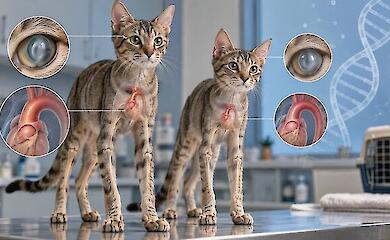
The study involved two mixed-breed brother cats, Gary and Shaggy. Both were found to have a combination of features characteristic of Marfan syndrome: long limbs, bilateral lens dislocation and aortic root dilation. Genetic analysis linked these changes to a rare variant of the FBN1 gene.
Details
Gary and Shaggy were littermates. Even as kittens, they stood out for their unusually long limbs. Subsequent veterinary examinations revealed bilateral lens luxation — displacement of the lens from its normal position — and aortic root dilatation.
It was precisely this combination of eye, aortic and skeletal abnormalities that led researchers to consider Marfan syndrome as a possible diagnosis. In humans, this hereditary connective tissue disorder is most commonly associated with variants of the FBN1 gene, which encodes the protein fibrillin-1. This protein is a component of the connective tissue in blood vessels, bones, ligaments, skin and the structures of the eye.
A histological examination of the ascending aorta of one of the cats revealed disruption and fragmentation of the elastic fibres. The authors note that this finding is consistent with impaired fibrillin-1 function and resembles the degenerative changes in the media of the aorta described in Marfan syndrome in humans.
Whole-genome sequencing identified a homozygous FBN1 variant — XM_023255387.2:c.2678-3C>A — in both animals. The mutation is located three base pairs upstream of exon 22 and affects a region important for correct RNA splicing. This variant was not detected in a comparative sample of more than 1,000 cats.
To investigate how the variant affects RNA processing, the researchers sequenced the cDNA of one of the affected animals using the Oxford Nanopore platform. Exon 22 was absent in approximately 73% of the transcripts. This affected the second hybrid domain of fibrillin-1, which is important for the correct folding and stability of the protein.
However, splicing was not completely disrupted. A small proportion of transcripts retained their normal structure, meaning the variant remained partially functional. The authors describe it as hypomorphic: it reduces the gene’s function but does not completely inactivate it.
This helps to explain the unusual genetic pattern. In humans, Marfan syndrome is usually inherited in an autosomal dominant manner, meaning that a single mutated copy of FBN1 may be sufficient for the disease to develop. Gary and Shaggy had two mutated copies, but thanks to the ‘leaky’ splicing site, part of the normal transcript was still produced.
The study’s senior author, Jacqueline Evans, notes that the findings may help vets recognise similar cases in the future and lay the groundwork for the development of genetic tests. However, the study itself does not constitute a ready-made commercial test and does not provide recommendations for mass screening of cats.
Why this is important
The study shows that the molecular cause of Marfan syndrome in cats may be similar to that in humans: in both cases, FBN1 and a structural abnormality in fibrillin-1 play a key role. This makes cats a potentially interesting natural model for comparative medicine and, at the same time, broadens our understanding of hereditary connective tissue disorders in domestic animals.
For veterinary practice, it is primarily the combination of clinical signs that is significant. Unusually long limbs do not in themselves indicate Marfan syndrome, but when combined with lens luxation and aortic root dilation, they may warrant further investigation and genetic diagnosis.
The study has significant limitations. Only two related animals from the same litter are described; therefore, this study cannot assess the prevalence of this variant, the frequency of Marfan syndrome in cats, or its association with specific breeds. It is also unknown to what extent this same mutation will be found in other animals with similar symptoms.
Furthermore, at the time of publication, *Scientific Reports* had published an early accepted version of the article: it has been peer-reviewed and has a permanent DOI, but may still be edited before the final version is released.
Source
Shawna R. Cook et al. A homozygous hypomorphic FBN1 splice region variant in domestic cats with Marfan syndrome, Scientific Reports, published 19 September 2026.
Cornell University College of Veterinary Medicine: First known cases of feline Marfan syndrome discovered in cat siblings, 22 September 2026.
Maria Grynevych, project manager, journalist, co-author of Guidebook Sacred Mountains of the Dnieper Region, Lecture Course: Cult Topography of the Middle Dnieper Region.
Related news
New Zealand has successfully restored populations of the country’s heaviest insect


Dogs distinguish words within a stream of speech by focusing on consonants

International veterinary certificate for pets: 6 things to check before travelling

Dogs seek the north, bumblebees play ball: 7 real-life studies of animals
Popular news

Scientists have identified which childhood experiences are linked to happiness in adulthood

Russian forces struck a public bus in Kramatorsk: 30 dead and 18 injured

Marfan syndrome has been confirmed at the molecular level in domestic cats for the first time

A Russian drone struck the South Bridge in Kyiv: metro services have been suspended

News about war

Russia is plotting to assassinate the heads of European defence firms in order to undermine support for Ukraine — FT

Trump announced an energy truce between Ukraine and Russia. A similar statement was made a month ago
Russian forces struck a public bus in Kramatorsk: 30 dead and 18 injured

The death toll in Pryluky following the Russian missile strike has now risen to 22, including five children