


Lost your property documents: 7 steps to prove ownership


It is not always necessary to go through the courts to recover lost documents. We explain how to check an old title registration and prepare to claim compensation.
If the title to a flat or house was registered before 1 January 2013, in certain cases it can be entered into the current register without the lost original document and without going to court. To do this, the registrar must find evidence of the previous registration in the electronic records or the BTI archive.
This procedure is set out in paragraph 53 of the Procedure for State Registration of Rights, approved by Cabinet of Ministers Resolution No. 1127. Its application is explained by the Interregional Directorate of the Ministry of Justice. This is particularly useful for owners of damaged or destroyed property who need to prove ownership for the ‘єВідновлення’ programme.
The guide covers properties where documentation has been lost but the title was previously registered. It does not replace the formalisation of inheritance or the resolution of disputes between claimants to a flat. The terms and availability of the services mentioned were verified on 19 October 2026; the steps are set out from checking records to applying for compensation.
Details
1. Check whether there is a title in the DRRP
Start by checking the State Register of Real Property Rights (DRRP). An entry may have been created following a previous transaction or registration, even if the paper document was subsequently lost.
You can obtain an information certificate via the Centre for Administrative Services (TsNAP). As of the date of this check, the ‘Dii’ online service page displays a notice stating that the service is temporarily unavailable, so you should not rely solely on this method.
If the required entry is found, show the result to the registrar or notary: it may no longer be necessary to transfer the old title to the DRRP. If no information is available, proceed to check the previous registration. The absence of a result from the electronic search does not in itself prove that the property right does not exist.
2. Determine exactly when the title was registered
For the procedure under paragraph 53, the title must have been registered before 1 January 2013 in accordance with the rules in force at that time. The year the house was built or long-term residence in it does not fulfil this condition.
Look for any surviving copies, photographs of documents or information about who registered the title and when. These will help you determine where to look for confirmation. If the property was never formally registered, transferring an archive record may not resolve your situation.
Sotsportal has previously written about confirming ownership rights without original documents. Here, we examine in more detail the process of checking old registers and the BTI (Bureau of Technical Inventory) — prior to applying for compensation.
3. Choose a registrar authorised to accept your application
Contact a state registrar at the Centre for Administrative Services (TsNAP) or a notary and check whether registration is possible at your property’s address. Explain that the document has been lost and that the title was registered before 2013.
Do not confuse obtaining a certificate with registering a title: the territorial rules for these procedures differ. The Ministry of Justice’s guidance on registration sets out the general rule that applications must be made within the region where the property is located, with exceptions for certain regions. Before travelling, check whether the specialist you have chosen can register your specific property.
4. Prepare the documents for your application
To begin with, you will need your passport, your taxpayer registration number, and any surviving copies of the lost document or details about it. The application for state registration is completed at the time of submission. If a representative is acting on your behalf, you will need documents confirming their authority.
You should not conceal the absence of a copy or substitute it with a random piece of paper: explain the situation and ask whether clause 53 can be applied. If a duplicate can be obtained from the authority or notary who issued the document, this is also an option. Archival registration is a separate procedure provided for by law, where the necessary information has been preserved.
5. Wait for the old register to be checked and, if necessary, the BTI
The registrar checks the Register of Property Rights in Immovable Property (RPRIP). This is an old electronic register which now forms part of the archives of the State Register of Property Rights (DRRP).
If confirmation of the registered right is found in the RPVN, the Ministry of Justice explains that it is possible to enter the details without additional documentary evidence or having to contact the BTI. If registration was carried out on paper only, the basis for registration may be the register books or registration files of the Bureau of Technical Inventory.
Check with the registrar how a response from the BTI will be obtained. Requesting the necessary information is part of their role; the registration service page on ‘Diia’ also describes an offline option, whereby a written request is forwarded to the applicant for them to submit to the BTI. If the former bureau has been wound up, you will need to find out to whom the archives have been transferred.
For registration purposes, it is essential to confirm that a previously registered right relates specifically to your property and is in the name of the relevant owner. The mere presence of any information about the flat in the archive does not mean that the verification process is complete.
6. Receive the registration result or find out the reason for refusal
Once registration is successful, keep the document you receive and check the property’s address, the owner’s details and the size of the share. As ‘Diya’ states, an electronic extract has the same legal force as a paper one.
The service description states a processing time of up to five working days, which may be extended to 35 working days if a BTI check is required. This is not a promise to restore any lost documents within five days. Registering an existing title via this service is free of charge, but a BTI certificate may incur a fee.
If there are no supporting records, or if the archive has been destroyed or is inaccessible, ask for an explanation of what information is missing. If it is not possible to confirm the right through administrative channels, court proceedings may be necessary. The absence of an entry in one register does not mean you must go to court immediately: first, check other available sources and the possibility of obtaining a duplicate.
7. Proceed to the application on ‘єВідновлення’
Once details of your entitlement have been entered into the DRRP, you can submit a claim for compensation or continue with the application process, provided the other conditions of the programme are met. Registration of your entitlement does not, in itself, guarantee payment.
For damaged housing that can be repaired, the process involves a damage report, a claim for payment and an assessment by a commission. For destroyed housing, separate compensation options apply — a housing certificate or funds for the reconstruction of a private house.
Do not confuse the DRRP, which confirms a registered right, with the Register of Damaged and Destroyed Property. A report of destruction does not replace property registration, and a property entry does not replace a claim for compensation.
Why this is important
Before taking the matter to court, it is worth establishing where proof of title is held: in the current DRRP, the old electronic RPVN, or the BTI’s paper archive. The next steps depend on the answer. If the previous registration is confirmed, clause 53 allows the matter to be resolved without a court ruling establishing the right; if there is insufficient evidence, another method of restoring documents or protecting the property will be required.
Source
- Interregional Directorate of the Ministry of Justice: Clause 53 and the use of archival information.
- Ministry of Justice on the Government Portal: documents relating to housing registered before 2013.
- ‘Dія’: state registration of rights to immovable property; obtaining information from the State Register of Rights to Immovable Property.
- Official website of the ‘єВідновлення’ programme.
- Original ‘Mist pidpory’ guidance on restoring property documents.
Maria Grynevych, project manager, journalist, co-author of Guidebook Sacred Mountains of the Dnieper Region, Lecture Course: Cult Topography of the Middle Dnieper Region.
Related news

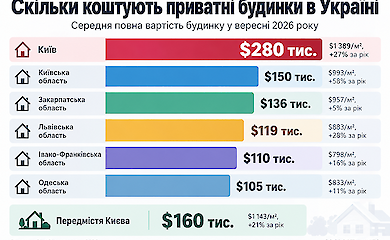
Detached houses in Kyiv cost an average of $280,000: prices by region




People are living alone more often than they used to. The problem is not just loneliness
Popular news

Genetic evidence of natural selection has been found in dogs near the Chernobyl Nuclear Power Station



A fish with a transparent head was filmed in 4K at a depth of 600 metres


News about war

Russia is threatening to destroy bridges, ports and power stations in Ukraine in order to secure territorial concessions from Kyiv – FT


Emergency power cuts have been introduced in Kyiv and warming centres are being set up — Klitschko


Zelenskyy confirmed that the Russian warning system had been hacked: Ukraine has responded to the Russian Federation’s cyberattack

Stephen Hubbard has returned to the US after four years in prison in Russia: what is known about his case