
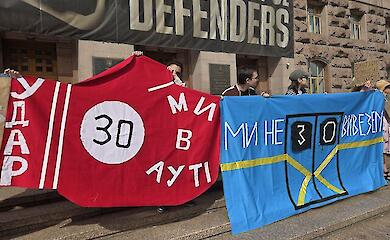
‘I’ve given up waiting for a prisoner exchange’: how a Mariupol defender survived four years in Russian captivity
- Home
- Frontline
- War in Ukraine. The storybook
- ‘I’ve given up waiting for a prisoner exchange’: how a Mariupol defender survived four years in Russian captivity


Vladyslav ‘Iskra’ (Spark) Zhuravlev, a member of the Armed Forces of Ukraine, spent more than four years in captivity after leaving Mariupol in the spring of 2022. In May this year, he returned to Ukraine as part of a ‘1,000 for 1,000’ prisoner exchange.
During this time, he endured physical abuse, information blackouts, a lack of medical care, surveillance of his correspondence, and the constant anticipation of a prisoner exchange that failed to materialise time and time again. Socportal has published his account of what helped him endure until his release.
The first few years, he says, were the hardest. Violence was meted out to both military personnel and civilians. Conditions only began to change gradually around the autumn of 2023, when inspections started to be carried out at the detention centres.
The early years were appalling in terms of conditions. In some places, there were no personal hygiene products at all. Cruel physical violence was inflicted on the prisoners – both military personnel and civilians. It made no difference whatsoever. Everyone was in the same situation.
According to him, conditions improved slowly, and much depended on the specific prison and its administration. In some places they were slightly better; in others, considerably worse. But one thing remained the same for all prisoners: information isolation.
Complete isolation from information: you know nothing about anything.
Sometimes the prisoners were allowed to watch Russian television. However, there was hardly any current news on it. They were shown old programmes, often starting them at random points. A significant portion of the airtime was taken up by Russian propaganda, in particular claims of a ‘victory’ in Mariupol.
The aim of this ‘information’, according to Iskra, was not so much to inform the prisoners about world events as to demoralise them.
They constantly repeat that Russia has already taken over the whole of Ukraine. They say that the authorities have abandoned us like cannon fodder, that nobody needs us and nobody will come to get us. And you hear this constantly, year after year.

Who are considered ‘traitors’?
According to Iskra, from around 2025 onwards, the food improved slightly, and beatings ceased to be a daily occurrence. Whilst violence was commonplace in 2022–2023, such incidents later became the exception rather than the rule, although they did not disappear entirely.
Medical care also remained a serious problem. The colonies’ medical units lacked resources, so even the staff were not always able to provide the necessary assistance.
Iskra particularly highlights the unequal treatment of different categories of prisoners. Formally, the rules might have been the same for everyone, but in practice, greater pressure was exerted on military personnel from combat units, members of airborne, naval and special forces, people with military or nationalist tattoos, as well as those from the occupied territories.
According to him, the Russian side viewed the latter not merely as enemies, but as ‘traitors’.
Among them was Iskra’s close friend, Denys Matsola, a former activist who had lived in Crimea and subsequently served in the Ukrainian Marine Corps. They were both taken prisoner in Mariupol. At the time of our conversation, Denys had already been in the penal colony for more than four years.
Iskra says that Denis was treated with particular cruelty. After being wounded, he also needed medical care, but obtaining it whilst in Russian custody was extremely difficult.
Letters, of which there were almost none
There was virtually no contact with the outside world. In over four years, Iskra received only a few letters from his mother and wife.
Prisoners were allowed to write letters themselves, but such opportunities were rare. Until 2026, they were effectively forced to use a pre-written template that they had to adhere to. According to Iskra, it contained anti-war and pro-Russian propaganda. Only after that could they add anything of their own.
All letters were checked.
You can’t write everything as it is when you’re in captivity. Because they might use physical force against you – simply beat you up. Although this rarely happens now, the possibility remains, and it’s important not to forget that.
Consequently, correspondence did not allow prisoners to tell their families what was really happening to them whilst in captivity.
Prisoners are being tried for ‘political extremism’
Separately, Iskra speaks of prisoners against whom the Russian side brought criminal charges. He himself was targeted for charges of ‘political extremism’ due to his activist work.
According to him, civilians may also be held in conditions similar to those faced by prisoners of war. If the Russian authorities bring criminal proceedings against an individual — regardless of whether there are genuine grounds for doing so — that person may be separated from other prisoners and put on trial.
The trial, according to Iskra, is often a mere formality. The person cannot choose their own lawyer – one is appointed by the state.
After sentencing, a person may remain within the Russian penal system to serve their sentence, although at the same time they may be included on lists for prisoner exchange.
The Russian system also attempts to restrict the exchange of information amongst the prisoners themselves. They try not to keep people who were captured in different years together, so that they cannot pass on up-to-date information about events in Ukraine to one another.
“Any grassroots initiative is viewed with hostility”
According to Iskra, the Russian system treated activists in a particular way. At the start of the full-scale war, the Russians were looking amongst Ukrainian prisoners for people who could be used to reinforce the propaganda narrative portraying Ukraine as a ‘fascist state’.
At first, they tried to portray Iskra as a supporter of National Socialist movements. In reality, he held Marxist views.
At first, they tried to accuse me of supporting National Socialist movements, until they finally realised that I was, in fact, a Marxist. That is a completely different camp, but they nevertheless continued with the case, albeit with less intensity.
He believes that the issue is broader than one’s attitude towards a specific political current.
They view any grassroots initiative with hostility. Anything that stems from a popular initiative—regardless of whether it comes from the right or the left—is seen by them as a negative element.

Why conditions began to change
According to Iskra, one of the factors behind the gradual improvement in conditions was that people began to talk more about Ukrainian prisoners of war.
Iskra said that international attention, human rights campaigns, inspections, and pressure on Russia gradually began to affect daily life in the prisons. The changes took place slowly, but he could feel them: heating and food improved, the staff’s attitude changed, and there were fewer beatings.
In the early years, when nobody knew anything, they had unlimited power there. They adjusted their own behaviour and decided for themselves what was allowed and what was not.
Later, various inspections began to be carried out in the detention centres. According to Iskra, representatives of the International Committee of the Red Cross were allowed onto the prison grounds, but they were not permitted to speak directly to the prisoners.
And yet, Iskra believes, the very presence of international and other organisations made a difference.
The heating improved, the treatment improved, there were fewer beatings, and the food improved. All this happened very gradually, with a great deal of resistance, but things are getting better.
That is why he considers it of fundamental importance not to stop talking about those who remain in captivity to this day.
As soon as people forget about this and stop talking about it, everything will come to nothing again. All this work will have been in vain. Everything will go back to the way it was before.
Do campaigns in support of prisoners of war help?
When asked about Ukrainian campaigns in support of prisoners of war, Iskra replies that there are two sides to this.
There may be negative consequences if the Russian security services were previously unaware of a particular prisoner’s activist activities. A public campaign could reveal this information and create additional problems for the individual whilst in captivity.
But if they were already aware of the person, as was the case with Iskra and Denys themselves, publicity, in his view, tends to help.
If they were already aware of a person – as, for example, they found out about Denys and me in the early days, since we had previously been public figures – then this had a rather positive effect on us.
According to him, once people started talking about them actively, even the attitude towards them during interrogations changed. There is also a wider impact. Such campaigns in Ukraine can increase pressure on the Ukrainian authorities, prompting them to pay more attention to specific individuals who are in a difficult physical or psychological state.
Therefore, on the whole, Iskra views such campaigns positively.
In most cases, these campaigns yield positive results. It is only in a few exceptional cases that they may have a negative impact.

The day he felt human again
After more than four years in Russian prisons, Iskra found himself in Belarus. He spent about a day there before returning to Ukraine. For the first time in a long while, he received medical care and proper food, and found himself in circumstances that, after years of captivity, seemed almost unreal. But what he remembered most of all was the chocolate.
When you haven’t eaten chocolate for four years, it makes a very strong impression.
Back in Ukraine, he was already able to choose whatever food he wanted. But emotionally, that moment wasn’t as significant: over the years in captivity, his body and mind had adapted to a different reality.
What helps you survive when you don’t know when you’ll return
When asked what helped him endure those four years, Iskra does not give a single universal answer. During that time, his way of coping changed. At first, he lived in anticipation of a prisoner exchange. It seemed to him that he might return home at any moment.
I’d wait a month, two months, half a year, a year, a year and a half. What’s going on?
In 2023, he was transferred to Mordovia – to a prison with a particularly harsh regime. There, he says, prisoners were forced to stand for up to 16 hours at a time. They were beaten. During this period, he says, he simply withdrew into himself and tried to endure this reality.
Later, the situation changed slightly. In 2024, the prisoners in his cell began to socialise more, even though this was officially forbidden.
If we really hadn’t communicated at our own risk, I would have had to remain silent for about three years, despite the fact that there were nine other people in the cell with me.
Conversations became an important part of life. The prisoners talked about books and TV series, and reminisced. And in 2025, when conditions had improved slightly, Iskra stopped waiting for an exchange. It sounds paradoxical, but it was precisely this refusal to wait that helped him carry on living.
I’d already stopped waiting to be exchanged. I simply came to terms with the fact that this was my life.
He calls this state the ‘starfish mode’: you find yourself in one place and simply exist.
I stopped waiting for something far off and started waiting for something close at hand.
Every little moment of the day became important: morning exercises, mealtimes, a chat with my cellmate, the chance to retell a story to someone.
Iskra would retell TV series and books to the others. A single such story could go on for months. It helped to pass the time and, at the same time, to stay in touch with other people.
That’s how the day went. Then the next one. And another.
Returning home does not mean that captivity is over
Following his release, some of the health problems that had arisen whilst in captivity began to subside thanks to proper treatment. At the same time, other consequences – both physical and psychological – began to make themselves felt. Iskra is currently in a military hospital. He is continuing his treatment, which is funded by the state, and remains a member of the armed forces.
Among the most common problems faced by former prisoners of war, he cites dental and vision issues. He himself has lost four teeth. His eyesight has deteriorated, partly due to constant artificial lighting and the inability to look at distant objects.
The lights are on day and night; you get no rest. And the only things you can see are right up close. In other words, there’s nothing in the distance.
He plans to have laser eye surgery. However, the hardest thing to cope with, after years of adapting to captivity, was a serious deterioration in his health as early as 2026. He developed trophic ulcers on his legs, and his usual coping mechanism ceased to work.
I really wanted to return, because I realise that some people in captivity died due to health problems that could not be resolved.
Four years in captivity taught him to live in very short bursts of time: not to think about when the war would end, when a prisoner exchange would take place, or when he would see Ukraine again, but to focus on the next conversation, meal, or opportunity to do some exercises.
And perhaps that is precisely what enabled him to endure.
Now Iskra is free. But he continues to speak out about those who remain in captivity. Silence, he says, can signal to the captives that they have been forgotten. That is why, he says, it is essential to keep talking about them.
Expert on women's rights, persons with disabilities, motherhood in the modern context, health care reform, education and social welfare.
Related news
Russia is plotting to assassinate the heads of European defence firms in order to undermine support for Ukraine — FT

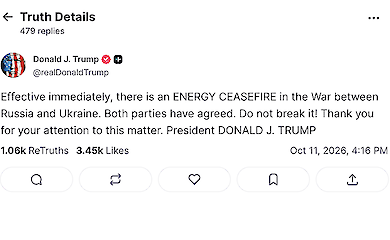
Trump announced an energy truce between Ukraine and Russia. A similar statement was made a month ago
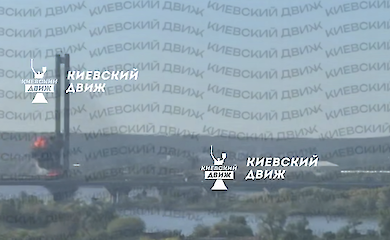
A Russian drone struck the South Bridge in Kyiv: metro services have been suspended
Popular news

Scientists have identified which childhood experiences are linked to happiness in adulthood

Russian forces struck a public bus in Kramatorsk: 30 dead and 18 injured

Marfan syndrome has been confirmed at the molecular level in domestic cats for the first time
A Russian drone struck the South Bridge in Kyiv: metro services have been suspended
News about war
Russia is plotting to assassinate the heads of European defence firms in order to undermine support for Ukraine — FT
Trump announced an energy truce between Ukraine and Russia. A similar statement was made a month ago
Russian forces struck a public bus in Kramatorsk: 30 dead and 18 injured
The death toll in Pryluky following the Russian missile strike has now risen to 22, including five children