


How the first people of the Americas settled the land


American archaeologists have studied around 500 Late Pleistocene stone spearheads from the Tennessee River Valley. The degree of wear and re-sharpening of the flint revealed how the behaviour of ancient hunters changed as their knowledge of local resources grew.
Around 13,000 years ago, at the end of the last Ice Age, the first settlers of North America were making their way through territories where no human had ever set foot before. Research by archaeologists, published in the *Journal of Archaeological Method and Theory*, has shown that the degree of wear and re-sharpening of stone arrowheads directly reflects the level of geographical knowledge and risk assessment among ancient hunter-gatherer groups.
Experts analysed around 500 flint points found in the Tennessee River valley, comparing the strategies of two successive Late Pleistocene cultures — the Clovis and Cumberland cultures.
Details
The study’s authors, Jesse Tune of the University of Mississippi and Shane Miller of the University of Alabama, turned to flint points as the primary surviving material from that era. Due to the high mobility of the hunters, few permanent long-term settlements remain in the region, so judgements about human behaviour must be based on lost or discarded tools.
The Clovis hunters, who appeared in the Tennessee River Valley around 13,200 years ago, were the first inhabitants of this territory. They did not know the exact location of deposits of high-quality flint (in particular, ‘chert’ flint), which was necessary for making weapons. Due to this high degree of uncertainty, the Clovis people used their raw materials sparingly: their arrowheads were repeatedly and meticulously re-flinted, pushing them to the limits of their usability. Although the arrowheads were originally intended as replaceable and expendable components of their weaponry, the risk of running out of raw materials in unfamiliar territory forced them to extend the lifespan of each item.
Several centuries later, the area was settled by members of the Cumberland culture (around 12,000 years ago), who had inherited knowledge of the location of stone deposits from their predecessors. A study of Cumberland arrowheads revealed a completely different pattern of behaviour: the points were also used, but they were regularly discarded whilst still intact and perfectly suitable for shooting. The hunters had no pack animals, so as they were constantly on the move, they strictly controlled the weight of the load they carried. Knowing where they could obtain fresh stone at any time allowed them to discard old tools and avoid carrying unnecessary weight.
Why this is important
This study demonstrates how archaeological finds enable us to reconstruct the behavioural economics and risk management of mobile communities. The difference in how tools were handled reflects a fundamental shift: from the cautious thrift of pioneers operating under conditions of complete uncertainty to the confident exploration of a landscape with a known network of resource points.
The authors note that this pattern is universal to humans when exploring uncharted territories. Tjun draws a direct analogy with modern research missions, including expeditions to Mars: when first entering an unknown environment, it is critically important to minimise the consumption of limited supplies and to calculate the payload precisely until local resources have been mapped and prepared for use. Limitations of the study include the regional scale of the sample (the Tennessee River valley), as well as the fact that the conclusions are based on the study of isolated tool finds rather than complete stratigraphic assemblages.
Source
Original study: Jesse W. Tune et al., ‘Foraging Theory and the Colonisation of Unfamiliar Landscapes: Assessing Late Pleistocene Projectile Point Reduction Strategies’, Journal of Archaeological Method and Theory (2026).
An independent researcher, interested in archaeology and sacred geography. He researches them and writes about them.
Related news

The ‘King’ of the Iron Age may have been a woman: what ancient coins reveal


A lock from a ship that sank in 1583 was uncovered using tomography
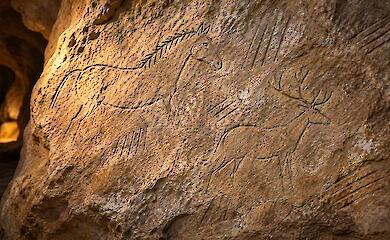
Hundreds of ancient engravings in a tourist cave in Spain had gone unnoticed for decades

Geologists have not found the source of Stonehenge’s Altar Stone in the areas of Scotland they have investigated

Popular news

Genetic evidence of natural selection has been found in dogs near the Chernobyl Nuclear Power Station



A fish with a transparent head was filmed in 4K at a depth of 600 metres


News about war

Russia is threatening to destroy bridges, ports and power stations in Ukraine in order to secure territorial concessions from Kyiv – FT


Emergency power cuts have been introduced in Kyiv and warming centres are being set up — Klitschko


Zelenskyy confirmed that the Russian warning system had been hacked: Ukraine has responded to the Russian Federation’s cyberattack

Stephen Hubbard has returned to the US after four years in prison in Russia: what is known about his case