


Food prices could rise by 10 per cent: what will happen to the price of medicines?

An economist has warned of the risk of rising prices for food and medicines. We compare his assessment with actual inflation figures.
Food prices in Ukraine could rise by at least 10 per cent, whilst medicine prices could rise even more sharply, according to economist Oleg Ustenko. Speaking on ‘Novyny LIVE’, he linked this risk to the weakening of the hryvnia and rising fuel costs. This is the expert’s forecast, not a decision that has already been taken to raise prices, nor is it an official forecast from the National Bank.
Details
Why the exchange rate and fuel prices affect the cost of shopping
Imported goods and raw materials are paid for in foreign currency. When the hryvnia weakens, purchasing the same consignment, when converted into hryvnia, may cost more. The cost of domestic products is also influenced by imported components, packaging, equipment and logistics.
Fuel is needed to transport raw materials and finished goods. Therefore, rising fuel prices may gradually be reflected in shop prices. However, the effect is not uniform: it depends on the proportion of transport costs, stock levels, competition and contracts with suppliers. One cannot automatically conclude that a 10 per cent rise in fuel prices will lead to a uniform 10 per cent increase in the price of all goods.
What has already happened to prices
According to the State Statistics Service, in September 2026 consumer prices rose by 2.1 per cent month-on-month and by 10.0 per cent compared with September last year. Food and non-alcoholic drinks rose by 1.9% over the month, fuel and oils by 5.2%, and medicines by 2.6%. These are actual changes over a specific period, not confirmation of a future 10 per cent surge.
The National Bank noted that inflation was influenced by damage to production facilities, logistics costs, imports and fuel prices. At the same time, trends varied across individual products: some goods became more expensive, whilst others became cheaper.
Why medicines may be more sensitive
For imported medicines, the exchange rate directly affects the purchase price. Further pressure may be caused by losses of stock and disruptions to logistics due to Russian attacks. However, the price of a specific medicine also depends on the manufacturer, the availability of alternatives and government regulation of mark-ups.
In September, *Ekonomicheskaya Pravda* reported that, in its sample of 99 popular medicines, 95 had risen in price between July and mid-September. The median increase was 10.3 per cent. These figures relate to selected items and prices quoted by pharmacies, and do not represent the inflation rate for all medicines in Ukraine.
Who, in the economist’s view, needs support
Ustenko believes that, as prices rise, state assistance should be directed first and foremost towards the most vulnerable: internally displaced persons, pensioners on minimum pensions, single mothers and people with disabilities. This is his proposal regarding social policy priorities, rather than an announcement of a new benefit or a change to the existing rules for receiving assistance.
Why this is important
If incomes do not keep pace with rising prices, people are forced to cut back on purchases or opt for cheaper goods. Rising prices for basic foodstuffs and essential medicines are particularly hard on households with fixed or low incomes. At the same time, the exact extent of future price rises is unknown: it depends on exchange rates, the cost of imports, logistics and other factors.
Source
Statement by economist Oleg Ustenko on the ‘Novyny LIVE’ programme — according to a report provided to the editorial team. The full recording and exact broadcast time have not been independently verified.
Statistics: State Statistics Service of Ukraine; National Bank of Ukraine. Analysis of medicine prices: a review of a study on the prices of 99 medicines.

Specializes in international relations and economic systems.
Related news
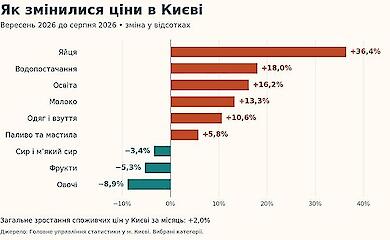
Eggs +36.4 per cent, vegetables −8.9 per cent: 7 major changes in prices in Kyiv

Why bread prices are rising whilst wheat is getting cheaper: 7 reasons

Global food prices have reached a three-year high due to the heatwave and conflicts

Popular news

Genetic evidence of natural selection has been found in dogs near the Chernobyl Nuclear Power Station



A fish with a transparent head was filmed in 4K at a depth of 600 metres


News about war

Russia is threatening to destroy bridges, ports and power stations in Ukraine in order to secure territorial concessions from Kyiv – FT

Emergency power cuts have been introduced in Kyiv and warming centres are being set up — Klitschko


Zelenskyy confirmed that the Russian warning system had been hacked: Ukraine has responded to the Russian Federation’s cyberattack

Stephen Hubbard has returned to the US after four years in prison in Russia: what is known about his case