
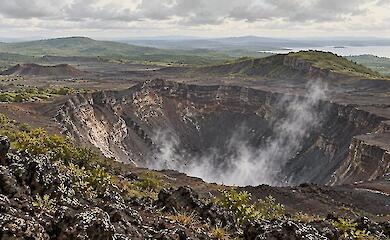

At the bottom of Lake Issyk-Kul, researchers are studying a town that sank around 800 years ago


The name of the settlement is unknown, and the reasons for its submersion remain a mystery for the time being.
Two cemeteries, the remains of an ornate public building and everyday objects are helping archaeologists piece together the history of a medieval town at the bottom of Lake Issyk-Kul in Kyrgyzstan. According to preliminary estimates, the settlement was submerged around 800 years ago.
Details
The ruins near Toru-Aigyr have been known since the 19th century, but systematic research has only begun in recent years. The name of the town and the size of its population remain unknown.
According to the researchers, the cemeteries discovered may date back to the early period of Islam’s spread in the region. The ornate public building could have been a mosque, a bathhouse or a madrasah – a religious school. Its purpose has yet to be established.
Among the well-preserved finds is a children’s potty, known as a tuvak. According to members of the expedition, similar items are still in use in Central Asia and the Caucasus.
The pottery will help to determine the age of the settlement and the places where the pottery was produced, whilst the animal bones will help to establish what the inhabitants ate.
Why this is important
The finds allow us to study urban life in a region whose history is often associated primarily with nomads. The settlement was situated on a trade route linking China with the western part of Eurasia.
The cause of the flooding remains unknown. Researchers are considering the possibility of a landslide or a rise in water levels caused by a natural barrier that may have formed following an earthquake. These theories have not yet been confirmed.
Source
An independent researcher, interested in archaeology and sacred geography. He researches them and writes about them.
Related news

The ‘King’ of the Iron Age may have been a woman: what ancient coins reveal


A lock from a ship that sank in 1583 was uncovered using tomography

Hundreds of ancient engravings in a tourist cave in Spain had gone unnoticed for decades

Geologists have not found the source of Stonehenge’s Altar Stone in the areas of Scotland they have investigated

Popular news

Genetic evidence of natural selection has been found in dogs near the Chernobyl Nuclear Power Station



A fish with a transparent head was filmed in 4K at a depth of 600 metres


News about war

Russia is threatening to destroy bridges, ports and power stations in Ukraine in order to secure territorial concessions from Kyiv – FT

Emergency power cuts have been introduced in Kyiv and warming centres are being set up — Klitschko


Zelenskyy confirmed that the Russian warning system had been hacked: Ukraine has responded to the Russian Federation’s cyberattack

Stephen Hubbard has returned to the US after four years in prison in Russia: what is known about his case