
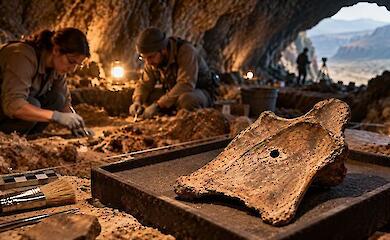
An X-ray has revealed how palm leaves were prepared for ancient manuscripts


Scientists used synchrotron radiation and machine learning to study the material of manuscripts written on palm leaves. The analysis distinguishes between different methods of preparing the leaves, but does not replace historical attribution.
X-ray analysis has helped scientists detect traces of palm-leaf processing in ancient manuscripts. The authors of the study, published on 6 October in the journal npj Heritage Science, compared 85 manuscripts and 75 modern samples using synchrotron radiation and machine learning.
The method makes it possible to distinguish certain features of manuscript production without damaging the fragile pages. However, the researchers are not yet able to determine, based solely on the data obtained, which country an unknown manuscript originates from.
Details
In South and South-East Asia, religious, legal, literary and scientific texts have been recorded on palm leaves for centuries. Before writing, the leaves were cut, boiled, dried, smoothed and sometimes treated with protective compounds. Detailed descriptions of these old recipes have largely been lost.
An international team, which included Laura Gallardo from the Hamburg University of Technology, examined 160 samples: 85 manuscripts and 75 modern samples, including untreated leaves and substrates prepared for writing. The materials were sourced from libraries, archives, research collections and other holdings. The analysis was carried out at the PETRA III facility at the DESY centre in Germany and at the ESRF synchrotron in Grenoble, France.
How X-rays detect traces of processing
The researchers combined three methods. Small-angle X-ray scattering helps to study the orientation of the fibres. Wide-angle scattering provides information on the structure of cellulose, whilst X-ray fluorescence analysis reveals the distribution of chemical elements. Machine learning algorithms then compared these features with the known characteristics of the samples.
The measurements were carried out without damaging the material under investigation. This is particularly important for rare manuscripts, from which it is not possible to remove small pieces for standard laboratory analysis. The study also utilised small fragments that had previously detached spontaneously from damaged artefacts.
What could be determined, and what could not
By combining these features, it became possible to distinguish between untreated leaves, modern writing blanks and historical manuscripts. When classifying by stage of processing, the algorithm correctly assigned 97 per cent of the relevant measurements to the manuscript class. However, this figure reflects the classification accuracy of the measurements, not the proven accuracy of recognising entirely new manuscripts.
The researchers also compared materials from two genera of palm trees — Borassus and Corypha. After the leaves had been prepared, the differences between them were more pronounced than in the unprocessed raw material. This suggests that the material’s properties reflect both the plant’s origin and changes that occur during manufacture.
Geography presents a greater challenge. The profiles of samples from Sri Lanka and southern India overlapped significantly. The Thai samples were characterised by a more pronounced combination of features, but the researchers can only speculate that this may be linked to local traditions of leaf processing. It is not yet possible to reliably determine the place of manufacture of an individual manuscript based on X-ray data.
Why this is important
Manuscripts preserve not only the texts written on them, but also traces of the production techniques used. Comparing fibre structure and chemical composition can help historians determine which methods of preparing the leaves were similar across different regions and how craft practices evolved. For museum specialists, the opportunity to study fragile objects without taking new samples is invaluable.
The method has significant limitations. Some manuscripts have an incomplete conservation history, geographical groups are represented unevenly, and ageing, previous conservation treatments and the original properties of the plants can produce similar changes. Furthermore, the validation of the algorithms was not organised as a fully independent test on previously unseen objects: different measurements of a single object might have been included in the analysis. Therefore, accuracy estimates cannot be automatically applied to new collections.
The authors regard the X-ray data as supplementary evidence that must be cross-referenced with the script, the manuscript’s layout, catalogues and historical sources. The first author of the study received funding from the German Research Foundation (DFG) as part of the ‘Understanding Written Artefacts’ research cluster.
Source
Laura Gallardo et al., ‘Multimodal synchrotron X-ray analysis of palm-leaf manuscripts: structural and compositional signatures of botanical genus, manufacture, and provenance’, npj Heritage Science, 14, article 527 (2026), DOI: 10.1038/s40494-026-03023-3.
Further information: press release from the Centre for the Study of Manuscript Cultures at the University of Hamburg, 15 October 2026.
Mykola Potyka has a wide range of knowledge and skills in several fields. Mykola writes interestingly about things that interest him.
Related news
Why did the kings of Norway need Sámi ancestors? Historians have re-examined the sagas


A fish with a transparent head was filmed in 4K at a depth of 600 metres

Up to 107,000 wild species have been identified as being used or traded


Genetic evidence of natural selection has been found in dogs near the Chernobyl Nuclear Power Station
Popular news
Genetic evidence of natural selection has been found in dogs near the Chernobyl Nuclear Power Station

A fish with a transparent head was filmed in 4K at a depth of 600 metres


News about war

Russia is threatening to destroy bridges, ports and power stations in Ukraine in order to secure territorial concessions from Kyiv – FT


Emergency power cuts have been introduced in Kyiv and warming centres are being set up — Klitschko


Zelenskyy confirmed that the Russian warning system had been hacked: Ukraine has responded to the Russian Federation’s cyberattack

Stephen Hubbard has returned to the US after four years in prison in Russia: what is known about his case