


A new species of an ancient relative of amphibians has been named after two mothers


Palaeontologists have re-examined an unusually well-preserved specimen from Maison Creek, dating back some 309 million years, and described a new genus and species: Jeanerpeton mazonensis. The genus was named in honour of the mothers of the study’s two lead authors, both of whom are called Jean.
Palaeontologists have described a new genus and species of ancient tetrapod — Jeanerpeton mazonensis — based on a fossil dating back some 309 million years from the famous Maison Creek site in Illinois. The paper was published on 24 September 2026 in the *Journal of Vertebrate Palaeontology*.
The specimen was previously known and had long been assigned to the species Amphibamus grandiceps. A re-examination of the structure of the skull and spine revealed differences from other Late Carboniferous amphibamiforms, which the authors deemed sufficient to establish a separate taxon.
Details
An old museum specimen has been identified as a separate species
The study is based on the Field Museum specimen, catalogued as FMNH PR 558. It was originally found by an amateur collector and donated to the museum. Previously, the fossil had been assigned to *Amphibamus grandiceps* — a well-known taxon from Maison Creek, to which various similar finds had historically been attributed.
The authors carried out an anatomical and systematic review of the specimen, paying particular attention to the upper and lateral parts of the skull and the axial skeleton. The original paper states that the combination of differences from contemporaneous and other Permian–Carboniferous amphibioforms allows for the description of a new genus and species.
Details that usually disappear have been preserved
Maison Creek is renowned for the exceptional preservation of its fossils. In the Field Museum’s press release, the researchers note that Jeanerpeton exhibits distinct eye impressions, patches of scales on the back, small abdominal ribs — gastralia — and traces of soft tissue.
The specimen was previously recognised as one of the oldest physical examples of structures similar to the finger pads of modern amphibians. The new study did not rediscover the fossil itself, but rather reassessed its taxonomic classification and demonstrated that the researchers were dealing with a distinct taxon.
The name was dedicated to two mothers named Jean
The lead authors of the study, Allison J. Sefkovic and Payton J. Kolberg, took part in the Field Museum’s Women in Science Interns programme. Both decided to dedicate the genus name to their mothers, who are both called Jean. The specific epithet *mazonensis* refers to Maison Creek.
In addition to Sefkowick and Kolberg, the authors of the paper were Calvin So and Arjan Mann. The study suggests that the diversity of amphibiforms at Maison Creek may have been greater than previously thought: the authors point to previously identified differences in the number of pre-sacral vertebrae in several specimens from this complex.
Why this is important
Jeanerpeton mazonensis belongs to the amphibimorphs — Palaeozoic temnospondyl tetrapods — which are important for studying the early evolution of traits associated with modern amphibians. However, it would be going too far to call Jeanerpeton a proven direct ancestor of modern frogs or salamanders: the paper primarily establishes a new taxon based on the anatomy of a specific fossil.
The study also highlights the value of re-examining museum collections. The specimen had been known to science for decades, but this new revision has enabled it to be removed from a broad ‘catch-all’ taxon and has clarified our understanding of the diversity of animals in the Maison Creek ecosystem some 309 million years ago.
There is a significant limitation: the description of the new species is based on a single, uniquely well-preserved specimen, FMNH PR 558. The authors themselves describe the broader conclusion regarding the diversity of Maison Creek amphibioforms as preliminary and link it to further study of other museum specimens.
Source
Allison J. Sefcovic, Payton J. Kohlberg, Calvin So, Arjan Mann. ‘Jeanerpeton mazonensis, gen. et sp. nov.: a new, exceptionally preserved, Late Carboniferous amphibamiform from the Mazon Creek Lagerstätte, Illinois’. Journal of Vertebrate Palaeontology, article e2698799. Received by the editorial office on 22 August 2025, accepted on 28 May 2026, published online on 24 September 2026.
The project for Allison Sefkovic and Peyton Kolberg was funded by the Women’s Board of the Field Museum and the Women in Science Internship programme. The article also acknowledges support for the Mann Lab research programme from the Lauer Foundation for Palaeontology, Science, and Education. The authors declared that there were no potential conflicts of interest.
Mykola Potyka has a wide range of knowledge and skills in several fields. Mykola writes interestingly about things that interest him.
Related news
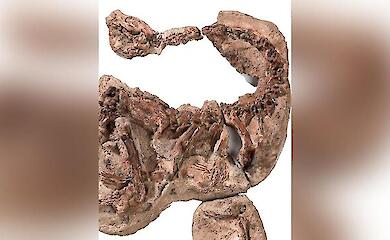
The ‘Hell Chicken’ may have fed on fruit: scientists have described a new species of dinosaur

An ancient sea in Colombia has shed light on an unusual transition in animal evolution
Footprints from the Dolomites have revealed how ancient reptiles changed their gait
Europe’s first megaraptor has been identified in the museum’s collection
Popular news

Genetic evidence of natural selection has been found in dogs near the Chernobyl Nuclear Power Station


A fish with a transparent head was filmed in 4K at a depth of 600 metres


News about war

Russia is threatening to destroy bridges, ports and power stations in Ukraine in order to secure territorial concessions from Kyiv – FT


Emergency power cuts have been introduced in Kyiv and warming centres are being set up — Klitschko


Zelenskyy confirmed that the Russian warning system had been hacked: Ukraine has responded to the Russian Federation’s cyberattack

Stephen Hubbard has returned to the US after four years in prison in Russia: what is known about his case
